
Hilarey.com

Intimacy with God for the Overchurched Blog

Menu
  • About
  • Books & More
    • Narrating
    • Contact
  • Coming of age series
    • Sovereign Ground
    • Heart of Petra
    • Sworn to the Desert
  • Historical Fantasy Series
    • Stone of Asylum
    • The Reckoner’s Blade
    • Heiress of Coeur d’Alene
Menu

Category: Context is Critical

Judge God

Posted on April 3, 2026March 31, 2026 by Hilarey
3 of 3 | Part 1 Judge Yourself & Let No One Judge You | Part 2 Judge No One & Judge Others | Part 3 Judge God

“I choose the appointed time; it is I who judge with equity. When the earth and all its people quake, it is I who hold its pillars firm. To the arrogant I say, ‘Boast no more,’ and to the wicked, ‘Do not lift up your horns. Do not lift your horns against heaven; do not speak so defiantly.’ ”No one from the east or the west or from the desert can exalt themselves. It is God who judges: He brings one down, he exalts another. In the hand of the Lord is a cup full of foaming wine mixed with spices; he pours it out, and all the wicked of the earth drink it down to its very dregs.””
‭‭Psalms‬ ‭75‬:‭2-‭8‬ ‭(NIV‬‬)

“If any man worship the beast and his image, and receive his mark in his forehead, or in his hand, The same shall drink of the wine of the wrath of God,”
“and great Babylon came in remembrance before God, to give unto her the cup of the wine of the fierceness of his wrath.”
Revelation 14:9-10 & Revelation 16:19 (KJV)

Where were you when I laid the foundations of the earth?

Even though much will be left unsaid, this is the final in the series. I love this picture I found for the post. I am mortal, lifting up scales to an eternal God.

An LDS friend told me her faith believes human souls are waiting in heaven for bodies. Hence, the need for large families, providing the bodies. I don’t know of Protestant faiths that believe their souls originated in heaven. Some believe it sparks to life at conception, but because God breathed life into Adam’s nostrils, I wonder if the first breath is significant. Some say our first and last intake “Yah” and exhales “Weh” makes the sound of God’s name, Yahweh.

I don’t want to focus on when the soul arrives, other than to say only God is immortal. It is arrogant thought to assume a part of us is inherently eternal. The idea of immortal souls didn’t come from Hebrew Scriptures; it came from Plato, and it’s understandable that we accept it because Greek philosophy shaped our Western thinking. The Bible Project talks about the word that is most often translated as soul here.

Return to dust, you mortals

You know the story—don’t eat from the Tree of Knowledge, or you will die. Was “die” hyperbolic? Did their soul/spirit die within their flesh at that moment? Are we assuming “you will surely die” meant God knew he would kick them out of the garden so they couldn’t eat the Tree of Life anymore, and then they would eventually die?

Job said his life came from the breath of the Almighty. After Jesus rose from the dead, he breathed on them and said, receive the Holy Spirit. So, I have wondered if this born-again breath is not connected to what perished in the garden.

All I understand is that, figurative or literal, access to the Tree of Life was granted and revoked in the garden of Eden, death entered, God desires none should perish (or die), but all would have eternal life instead—and the end of the book, Revelation 22 describes access granted to the Tree of Life again in our future so we will live forever.

It’s probably too ingrained in you, from the foundational philosophers of Western civilization, to let go of the idea that some part of you will live forever, naturally, in your own power, even in rebellion to God.

This is the context I am coming from. I do not believe any part of us is inherently eternal—and I’ve highlighted this to show my fearsome reverence for God, before I share my boldness on judging him.

“I said, ‘You are “gods”; you are all sons of the Most High.’ But you will die like mere mortals; you will fall like every other ruler.” Psalms‬ ‭82‬:‭6‬-‭7‬

Taste, and see

  • When you first turn to God, you have judged him worthy.
  • Every time you submit, and believe his definition of sin, yielding a bit more of yourself to him, you are making a judgment that you can trust him.
  • When you do not do what he commands, you are judging him untrustworthy.

We’re invited to taste and see that the Lord is good. An action that results in consideration, opinion, and finally declaring a verdict on God.

In my last post, I wrote about our divine desire for justice because we’re made in the image of the righteous judge. Do you think God would give us the desire for justice and the ability to judge, but then tell us not to use it on Him—as though the giver of that justice might not stand up to it?

This concept of measuring God is unfamiliar to me. And these are probably new thoughts for you if you were raised to fear God, hell, Satan, sinners, your parents, an unchecked government, the world, hip-hop, and yourself. But taste and see—how could you walk boldly into the throne of grace if you’ve always believed he is arbitrary, punitive, and unjust?

Look at the language God uses in Isaiah, “Come now, let’s us reason together.” This is a God who wrestles with humans. Moses and Abraham both verbally sparred with God to intercede for the ones they loved. Although love might be a strong word for what Moses felt for the Israelites…

Jeremiah has a humble posture when he comes to God and says he’d like to have a word with him, but look also at his boldness.

“Yet I would speak with you about your justice…
You will be in the right, O LORD, when I lay charges against you,
but let me put my case to you.
Why does the way of the guilty prosper?
Why do all who are treacherous thrive?”
Jeremiah 12:1

Is this not the cry of your heart right now? How much healthier to lay it out on the table than to pretend like you aren’t lifting scales and inspecting the balance, waiting to see what the Lord will do. Stand on the edge of the cliff with Abraham and the Lord and echo, “Will not the judge of the earth do right?”

Come now, first let us reason together ways not to judge God

Do not judge God by

  1. his leaders
  2. an (English) translation
  3. your limited knowledge
  4. how you think this story should end
  5. the people who smear his name
1. Do not judge God by his leaders, even the chosen ones like Saul

I mentioned last week that Eli had two sons who used their religious power in the temple to oppress financially and sexually. Eli knew about it and confronted them, but just as we saw in the recent SBC scandals (and have seen in many others) no one was punished and often not even restrained. Eli’s bloodline was supposed to be priests forever. God’s answer is that he will still honor his promise to the lineage, but the two guilty sons will die on the same day. Additionally, every descendant of theirs will die in the prime of life.

Eli still doesn’t punish them.

Samuel comes on the scene as a weaned child and in a sweet story hears God’s voice in the night. In the morning Eli wants to know what God said, but young Samuel doesn’t really want to tell him, “Uh, sir, God said your sins cannot be atoned…” Verse 14. They could not be atoned by anything Eli currently did in the temple. There was nothing set up under that priesthood that could atone for it.

But Eli convinces Samuel to be scary-honest. Verse 18, “So Samuel told him everything, hiding nothing from him. Eli replies, “He is the Lord; let him do what is good in his eyes.””

So great is the irreverence of Eli’s two sons, who have wielded religious power their whole lives, that they take the Ark of the Covenant out to the battlefield like God is also theirs to wield. 1 Sam 4 says the slaughter was great; Israel lost thirty thousand foot soldiers. The Ark of the Covenant was captured, and Eli’s two sons, Hophni and Phinehas, died (just as promised on the same day.)

When Eli hears his sons are dead and the Ark is captured—it is news of the Ark that devastates him. He was quite heavy. (Maybe he also benefited from those first-choice cuts of meat that his boys were stealing.) Eli falls back from his chair, breaks his neck, and dies. Then his daughter-in-law hears and dies giving birth. Already the family line is perishing in the prime of life. Eli had led Israel for 40 years.

God will deal with corrupt leaders—and keep his promises at the same time. That we want and need him to, illustrates how everything inside us cries out against the problem of sin and iniquity.

Rethinking Hell is a heady collection of essays from multiple scholars about conditional immortality. On page 216 note 35, one argues, “However, if God is the author of morality, God‘s own actions must ultimately be shown to conform to the moral principles God imposes on humanity…”

God presented Christ as a sacrifice of atonement…to demonstrate his righteousness. Romans 3:25–26. The fact that it’s a demonstration means it’s an invitation to observe and judge. God has come to an unbelieving world and put his character before us to win our fear, repentance, and love.

2. Do not judge God by translation philosophies

The Bible only says that it is useful for training, and not one jot of the law will pass away until everything is finished. The Bible does not say your understanding of the translation in your hand in inerrant.

I’ve talked before about spiritual bypassing and cognitive dissonance by shrugging our shoulders and saying, “The Lord is mysterious, and I can’t trust me.” Growing up in church can be a little like the story of the Emperor’s New Clothes. This is how it seemed to me when my kids started talking. They pointed out things that I had practiced ignoring. I was in the habit of believing, “I can’t understand that. I’m sinful. I’m uneducated. God is sovereign.”

Christians are sometimes the crowd around the emperor, assuring the world they see elegant clothes with cheap phrases and pat answers. That hasn’t worked for the generations who’ve had access to a wider community and can ask the internet if they don’t buy the platitudes.

Sometimes the problem is in the translation itself or the translation philosophy. Like an idiom lost to time, some words would have made sense to the reader but don’t show up anywhere else in the Bible, so the nuance has to be assumed. Sometimes it’s taking the Bible too literally, when it so often uses hyperbole. Sometimes it’s not having a comparable word in the target translation. But people dedicate their lives to digging into those things, and we also have access to those scholars, books, podcasts through the internet.

This actually happened to me this week when I read David appointed his sons as priests. I was like, “Hold the phone, they aren’t Levites!” I already suspect some of David’s motivation and political maneuvering so I needed to know what was going on.
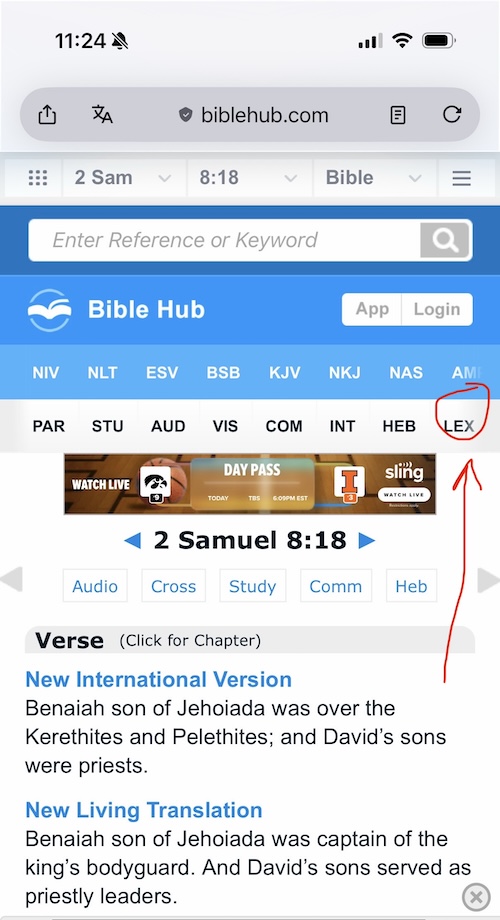
Apparently, this is a known discrepancy. Bible Hub is my favorite free resource for viewing multiple translations side by side. And the Lexicon button shows the Greek or Hebrew of the verse. If you click on a word, you can see where else it shows up in the Bible. The word used for priest regarding David’s sons does not refer to the official Aaronic Priesthood.

It’s more likely that they were officials put in charge of ministering. Neither is it the same word that we use for a kingdom of priests according to the order of Melchizedek.

Appreciate the Internet with me for a minute. Previously, it would have taken a very special complementarian pastor to answer all of a girl’s questions without assuming she wanted to usurp his authority and/or sleep with him.

I know it’s not always that simple. Some things in the Bible have no clean answer yet. If you only have a few minutes to spend in a devotional each morning, the writer probably isn’t going to highlight the Psalm, “May his children be wandering beggars; may they be driven from their ruined homes,” with a touching personal story.

That’s because, translations aside, there is tension in the Bible. It is a place where often two things are true. Consider when Jesus broke the law, broke the written law and healed a man on the Sabbath. He said in John 7:24, “Do not judge by appearances, but judge with right judgment.” He’s telling the Pharisees here that there’s something else besides the literal interpretation of what they have written down in front of them.

3. Do not judge God by what you know that you know

Because we only know a part, we have to make tea and settle into the mystery.

Consider that scholars were cranky because John the Baptist didn’t eat and drink, and equally cranky because Jesus did eat and drink.

Peter knew Christ was the Son of the living God. You can see how this plays out ten verses after he declares that truth. Peter knows what he knows and therefore contradicts when Christ tells them is going to die. Don’t judge God by the pain and death that we know doesn’t need to be happening right now. Like Peter, we don’t understand everything going on, and all the powers at play.

I believe it was the human weakness in Christ that needed to rebuke Peter’s temptation to not go to the cross. There wasn’t a problem with Peter being his normal inquisitive, impetuous self. With careful words we still call out that we don’t see any clothes on the emperor. Suppressing the thought gets you sideswiped by the enemy’s philosophies. When you tell yourself, “God is God—shut up and take the free ticket out of hell!”

The spiritual person judges all things, but is himself to be judged by no one. 1 Corinthians 2:15

4. Do not judge him on how you think something should play out

I have an annual Hallmark Christmas movie night with a writer’s group. We call out story elements, write, and rewrite the story as we’re watching. Some of the gals are shockingly spot-on, as though they wrote the screenplay. I like to try guessing cheesy lines and say them just before the character does. But genre fiction follows a predictable story arc with mandatory components. There is a reason people love it. No surprises equals “emotionally safe.”

My dad asked me when I released Stone of Asylum, “If I read this story—is it going to be worth it?” Not counting the cost for some people to suffer through a book at all—this is a question of whether he can trust me, the author, with his time and the ending. I told him, “Probably not.” My martial arts trilogy is a dark retelling of the Count of Monte Cristo. I explore the theme of revenge and how a story might unfold if a human had the power to exact it. I had fun—but my writing contains no gifts of comfort or reassurance for the reader. It takes trust to follow a writer to the end of their novel, whether or not you first check the last page to see who lives.

But even if we know “God wins,” it doesn’t mean every chapter is going to make sense. Acts 21 is interesting to me because the local church urges Paul “through the spirit” not to go to Rome. See, the Spirit revealed to them that Paul would die in Rome. One man prophesied that the owner of this belt will be bound “like this.” And Paul asked them, “Why are you weeping and breaking my heart?”

Paul knew what he was called to do. He had been told that he would stand before Caesar. The same Spirit showed both Paul and the believers the same thing, but because humans have autonomy, they had different reactions to what should be done with that information. This dethrones the idea that “I have word from the Lord for you” also means “I understand all the details and here’s what you should do with your life.”

It also reveals that even if we have a promise, the path to get there isn’t predictable like genre fiction. Abram experienced famine, war, kidnapping, and years of barrenness before his promise came. David was anointed king, but the path involved running for his life, losing his best friend (who had sworn to be his second) as well as a lot of crafty political maneuvering and marriages before he established Jerusalem as the political and religious center.

As we wait for our promises with the assurance that God will wipe every tear—understand this reality: it just means there will be tears.

He knows we will judge his trustworthiness based on his fulfillment of promises.
Fulfill your promise to your servant, so that you may be feared. Psalm 119:38.

5. Do not judge him by how others use his name

This is the one that I continually struggle with. I cannot for the life of me understand why God lets people do evil in his name. And I will leave it at that because I have no answer.

Won’t Ihen you see the phrase in the Bible, “For my name’s sake,” pay attention. Hebrews 6:13 says God swore by his own name because there was none greater. Blasphemy of the Holy Spirit is unforgivable, and most people try to reconcile “unforgivable” by saying it means rejecting the call of God even to the point of death, so you’re dead and your chance is over. But I wonder… is it not more serious than we realize when people blaspheme God’s name by falsely attributing good and evil to the point of drawing others away from him?

If people profane his name by committing atrocities and justifying it because they are “chosen,” the answer is not to cover it or look away. And it isn’t to decorate God’s actions with half-truth rationalizations. Elizabeth Eliot had a problem with the way Christians try to make God look good to defend him and said the way they fluff him is specifically a problem with Christian fiction. P. 126 & 129 Being Elizabeth by Ellen Vaughn.

It seems like many would rather protect the image of God than bear the image of God, especially when it is maligned. And protection is only needed if you do not believe he can protect his own name.

The problem of sin

The problem of sin/pain is a problem of free will and how we think God should deal with both.

Hold the tension of when Peter was indignant/ashamed/confused that Christ had de-robed and kneeled down to wash Peter’s feet. Like in so many other places, I’m glad here, Peter didn’t throw away his challenge, pretending he could see clothes.

I’m finishing a Lenten devotional this week called 40 Days of Decrease by Alicia Britt Chole. She highlights that at the Last Supper Jesus washed the feet of a betrayer, a denier, and ten deserters. He held the bread and wine out to each one, anyway.

Whether you are one of the ones who anointed him for burial weeks before, or you sit at this feast with questions and decisions—everything hangs on how you judge God.

And this is the point where we cannot cling without the grip of faith for parts yet unfulfilled or misunderstood. You can read the Bible prepared to be cranky when God eats and when he fasts—or you can look searching his loyal love. But we don’t need to pretend we see the emperor’s new clothes. Our naked king removed his own clothing and invites you to look upon him.

“God‘s character and conduct aught to win faith, not to be sustained by faith against appearances.” One of the essays in Rethinking Hell reiterates the invitation to a fallen world to judge who he is. “…we may be sure that the judge of the earth will do right, not merely in his own eyes, but in those of all his intelligent creation.” P. 199-201.

Chole also wrote in 40 Days of Decrease that the last time Judas spoke to Jesus he called him “Rabbi.” And the last time Jesus spoke to Judas, he called him “Friend.” The author explains, she remains “in that messy place theologically where God’s Sovereignty and human freewill co-exist.” P. 137.

I’m sorry that you came all this way and will not leave you with a tidy conclusion—save, trust the author to the end of the story. Confounding chapters of his grace play out everywhere you look—when you aren’t trying to write them.

Uncovering Paul

Posted on June 27, 2025June 25, 2025 by Hilarey

Soon after 9-11, my oldest came home and prayed for the Muslims because “They make their ladies cover-up their heads.” I’m not sure where he got this, but people were turning all Muslims into caricatures of chaotic evil. It is interesting that this most grievous thing was given to my six-year-old as a prayer-worthy concern.

I first wrote about questioning my pastor regarding head coverings in my post Uncovered, and lately I realize that there have been very few pastors I haven’t asked multiple questions or wanted to dialogue “Why is (this) so?” In that instance, he didn’t know. And I don’t think he really cared. I mean, it applied to a different gender, culture and time than he did. Neither did it affect his authority to operate in the church.

Recently, I found great pleasure reading the book Vindicating the Vixens: Revisiting Sexualized, Marginalized and Vilified Women of the Bible, edited by Sandra Glahn. It was so beneficial (to me) to clarify the context of several Bible stories—and it’s the same reason I’m also enjoying Paul and Gender—Reclaiming the Apostle’s Vision for Men and Women of the Church by Cynthia Long Westfall. I’ve only just started it, and like Vindicating the Vixens, the first chapter is bringing me a completely different world-view/paradigm/cultural lens to Paul.

A fiction author I love once wrote a character to say she had no problem with Jesus. It was Paul she didn’t like. My feelings bordered on mutual—but I’ve been pressing into trusting that God is good. So, if a thing isn’t good—either it isn’t from God, or it’s misunderstood. So I ask, seek, knock, clarify. Lately, that’s manifested as reading Paul and Gender and switching my Bible app to track scripture through “the life of Paul.” So I can press in for the good about his writings.

I already knew Paul’s command in 1 Corinthians 11 to keep a woman’s head covered was more about protection and equality for the first century church than keeping a modern woman subservient in a display of culturally irrelevant, historic modesty.

Still, my head covering ignorance and a western context of systemic power disparity and exclusion made the passage difficult to digest. America’s lens was refined by beliefs like “all women are born that they may acknowledge themselves as inferior in consequence to the superiority of the male sex,” from John Calvin. So of course we looked at 1 Corinthians and said, yeah—Paul wants the women’s heads covered as a symbol of male authority. Men don’t need it since they’re directly under God… See that Calvin quote, and more, compiled by a blog I follow here.

So as we chew on the meat and spit out the gristle from our Western Schism church fathers, I love how Paul and Gender paints a more wholistic backdrop. Here, I hope to lay some of it out and evoke a metaphor of my own*. This is just one take on the passage, and I think people will study it more and more—now that women can officially open a bank account. I have to remember that only happened the year I was born. This is only the first generation of people entering seminary with an inherent interest instead of “Not my gender… doesn’t affect me.”

Our American belief is that a woman would never want to cover her head. In the breathtaking book A Thousand Splendid Suns by Khaled Hosseini, the heroine receives a hijab. (My heart swells just thinking of that story.) Her initial reaction is that she feels treasured and protected. This was my first inkling of a different take on head coverings.

But every woman who prays or prophesies with her head uncovered dishonors her head—it is the same as having her head shaved (NIV)

Let’s set the scene of the church in Corinth. Paul and Gender said “A woman of Corinth” was a euphemism for a prostitute.

From other reading, I’ve also understood that the setting is a time and culture where men can penetrate anyone they conquer or are in charge of—and it isn’t considered rape, homosexuality or adultery. It was culturally benign for them, like a spayed or neutered humpy dog. Merely a socially acceptable display of power.

And how do they know if a particular woman is off-limits? Her hair is hidden. A veil is the signal defining which women are protected and which are sexually at risk in this city where men with money and power can dominate anyone. If this conjures #MeToo and Epstein Island…the difference is: it isn’t socially acceptable. It doesn’t sit well with us.

Additionally, the veil maintains social class order. From the women’s perspectives, it’s hierarchy showing who has value. This woman is worthy and protected. This one is lesser, usable, discardable. For sale. We know social oppression was going on because the Corinthian church was jealous and quarreling with each other. Paul suggested they were doing more harm than good when they gathered because one would be drunk and another would go hungry during the Lord’s Supper. Paul and Gender said the law forbid a slave or a prostitute from covering her hair. So imagine the social oppression of a woman who had “no right” to cover up. “Who does she think she is?”

With head-coverings, a certain kind of man can scan a room and immediately see which woman he could have, and who is off-limits. Incidentally, modern men who are terrified of androgynous and transgender clothing still make me think of the certain type of person who wants to walk into a room and quickly ascertain who he could potentially dominate. I think it makes them uncomfortable not to know who they can fight or sleep with immediately.

Ok, still building the stage. Now take the cultural example of human (not chicken) breasts. In some places in the world, a woman’s exposed breasts aren’t immodest. But use our Western sensibilities and imagine a topless (topfree) photo in a magazine or behind a paywall—a picture of a woman’s breasts makes her “available.” You can see her nakedness so you can consider having her, imagine having her, or pretend.

Take that into a house church. They’re using the language of fictive kinship, calling each other brother and sister. And, at home, mom and sis take their veils off. And some guy thinks, “I’m curious what so-and-so’s wife looks like uncovered. After all, we’re, ahem, family.”

Let’s have all the ladies take off their veils!

Now, sister, stand before the congregation. Not a bare-chested home church in Indonesia at the turn of the 19th century, but a gathering in America. You’re about to deliver a message from God, to speak and to prophesy to the congregation. But first, they want you to take off your shirt. Since many of the Corinthians believers are “lower status,” the ex (or current) sex slave you’re sitting next too—I’ve seen her naked. And you’re my family. I should see you. Now stand straight and give the message with uncovered areola and nipple.

Just let that visceral feeling you have land and settle for a minute. It might give you a bit of empathy for the forced unveiling of a Muslim woman or a first century Corinth lady.

Modesty is cultural. If the woman has never had her hair exposed, it drapes her in a sexually vulnerable, naked sensation (and possibly position, depending on the crowd.) In Corinth, it would have felt shameful to some women. As shameful as having her head shaved—the punishment for infidelity and promiscuity. Shame is a particularly difficult emotion in that it is so isolating. Flowing hair would have been highly arousing to some listeners. I imagine some brothers in the church wouldn’t even hear your message if you stood bare-chested before them—even though boobies are available to see anytime, online. (I guess for some it wouldn’t even matter if you’re covered up. They still know you have ’em and they’ll look right through your shirt!)

Now, a slave girl whose entire life has been exposed and marked by her availability, low class and low worth, stands before the crowd and speaks to a congregation. A group which possibly includes her owners. In any other context, they are her social superiors and her uncovered head is the blatant visual reminder.

Paul’s directive is “all you all” women wear veils.

Equality in the church. Protection in the church.

Paul said something different to Timothy regarding the women of Ephesus who ostentatiously flaunted wealth and status. He told them to show appropriate situational propriety in their adornments like braided hair. But to Corinth, he addresses their specific issue and says, “Here, in the gathering of believers, no one is low class. No one is unprotected. No one is sexually available. Listen to her words and don’t look at her like that, Corinthians.”

A man ought not to cover his head, since he is the image and glory of God; but woman is the glory of man (NIV)

Additionally, there’s a contrast with the directive that the men should not cover their head. Paul and Gender suggests that a man of high status would want to be invisible when in a posture of supplication. It was the cultural norm for him to cover that up. Paul says, rather, males are to be vulnerable, with their “spiritual transformation is on display.”

A man’s uncovered head doesn’t bring up sexuality to the imagination of the hearers, it lowers him from his elevated status to equal, to fellow believer. “Exchange a covering of pride for exposed humility, all you men who could dominate anyone.” This would have been as jarring as some of the other things Paul said to them, such as, “You are all the bride of Christ.”

But here’s an even lovelier thing about this letter from Paul! He gives it to the Corinthian church as a non-contentious individual church decision. Because the other churches aren’t dealing with it. Verse 16.

Paul wants the church to learn to discern and make decisions because it will one day judge the world and angels.

Paul and Gender, page 35 says, “Women and men were supposed to be learning to exercise good judgment in ordinary matters in preparation for future responsibilities. Therefore, if women were (correctly) refusing to submit to suggestions or directions to not veil or to remove their veils, the Corinthian Church needed to be convinced that women should be allowed to use their own judgment or follow their own convictions in this matter.”

How can I not love Paul for this?

Westfall also asserts that the veil is a demonstration of her choice, her authority over herself. She writes, “However, as the subject of the sentence, the nominative woman is the subject of the infinitive, the one who has authority.”

It is for this reason that a woman ought to have authority over her own head, because of the angels (NIV)

So the Corinthian head covered is a symbol of her own authority over her own head as she stands before God and the heavenly realm. This is why (counter-culturally) Paul tells a lowly slave girl to illegally wear a veil when she prophesies over the congregation in the privacy of a house church.

This unmarried girl is not veiled to signify the authority of men. She is elevated to equal status to the rest of the congregation before the Lord. Because God uses the things this world despises to shame the powerful. And she gets to make her own choice if she wants to display her hair when she edifies, strengthens, encourages, comforts and instructs the people**.

Diving into scripture like this reveals God’s intentions regarding our interdependence and treatment of each other—not to split hairs over hair scarves and cleavage. When a woman enters the four walls of your church building with more or less covering indicative of the life and culture she lives—remember:

Don’t look at her that way. Listen to her words.

*Thoughts from Paul and Gender are mingled with my own. So if there is something incorrect or irritating—assume it is me and not the book or the author.
**I was raised in a congregation and spent time in churches that believed in Cessation. Looking back now, I wonder if the doctrine has a purpose to maintain control from the top down, with the added benefit of avoiding a text which refers to women instructing men. I cannot find a compelling reason to believe in the cessation of (some) gifts, because prophecy (specifically) is the only gift that shows up in every list I can find regarding spiritual gifts. And, we’re warned to not suppress it. See 1 Corinthians 12:7-11, 27-30, Romans 12:6-8 & Ephesians 4:11-13. Keep reading the first letter to Corinthians to see details about how prophecy should look.

1 Corinthians 14
Vs 3 the one who prophesies speaks to people for their strengthening, encouraging and comfort
Vs 5 so that the church may be edified
Vs 22 it’s for believers
Vs 24-25 it’s for unbelievers to be convicted of sin, their hearts and secrets laid bare, it incites worship
Vs 29 two or three should do it taking turns, it should be weighed for truth
Vs 31 says prophecy is for instruction and encouragement, and all should have a turn

You’ll notice, a few verses later, Paul says women should be silent in church. Which contradicts Chapter 11 if you think Paul tells all women to prophesy and all women to be silent in the same letter. I assume Paul and Gender will cover this, but I haven’t gotten to it yet. The explanation I’ve previously heard is that verse 34 & 35 had to do with women who’d never previously sat in a learning environment or studied spiritual things. They were randomly interrupting the service, calling out questions across the room. He tells them to wait and go home to ask their husbands instead of being disruptive. If you get too fixated on the inerrant letter of your translation—you would think only married women get to ask clarifying questions and single women have to wonder about God until they have a husband. All of chapter 14 chapter is about removing disruptions and creating order while using tounges and prophecy, so this makes more sense than women being told not to speak unless they are prophesying, but men can interrupt willy-nilly.

prayers in cracks of the wailing wall, 2018

Kicking Bricks & Flipping Tables

Posted on April 18, 2025July 8, 2025 by Hilarey

I’ve heard foundations cannot be changed. (I feel like this is said when people describe how America was started as a Christian nation and therefore it could never not be a Christian nation.) But sometimes houses are moved from their foundations and placed in other areas. You can also lift a house and pour a new foundation—it’s just very costly.

So before you need to relocate the whole structure, I think it’s a good policy to not assume that you have a totality of the gospel already inside of you. Sometimes I prefer to seek affirmation for things I already believe, but when I approach the Bible with curiosity rather than angrily seeking confirmation—I usually enjoy it more. (Although, looking for something you know can be healing when it refutes lies. And a little confirmation bias does give a jolt of dopamine.)

I’m not an architect or an engineer, but my simple understanding is that if there is a crack in your foundation, it doesn’t mean you should heap more weight on top. When you do that, and the earthquake comes, you’re more likely to lose your faith completely.

Although they have built thousands of years on top of the stones where Jesus walked.

prayers in cracks of the wailing wall, 2018
My trip to (and under) the wailing wall in 2018.

Be willing to walk around the house and kick the bricks, checking for cracks in your foundation. Because we repeat so many things that are not actually biblical.

Not a Lender Nor a Borrower Be

One thing I was told with such authority was, “the Bible says to never lend or borrow.” I keep digital notes when something comes up during my Bible reading. That way, I can see them wherever I go, and add to them whenever I have space to process. The words I jot down could be anything from beautiful, resonating, irritating, confusing… but I especially like to add things that contradict either my paradigm or something else I’ve read in the Bible. This is how I kick the bricks of my foundation.

The first time I read, “You will lend to many nations, but borrow from none” in Deuteronomy 28:12, I thought to myself, “this contradicts not a lender nor a borrow or be.” So I did a quick search: “What does the Bible have to say about lending?” (I love digital Bibles.)

It says to not be tight-fisted to the poor. And when (not if) you lend, do not charge interest. I should lend.

I can’t find it telling me not to borrow, either. It says “the borrower is a slave to the lender” in Proverbs. Therefore, I want to have prudence when I decide to borrow because I am giving over my freedom until the debt is paid.

Proverbs is a collection of truths perceived by a wise person, but I don’t ever want to take one verse from it and turn it into a non-negotiable mantra. Otherwise I would get whiplash when I read chapter 26 verses four and then five.

As it turns out, the scripture “not a lender nor a borrower be” is from Hamlet. You can watch the Skipper sing it on Gilligan’s Island here.

My girlfriend calls that “the pizza bible.” You just say things you want or believe with authority and call it scripture. The bible says to bring me a pizza.

But you can also eat from the pizza bible it by taking things out of context.

Happy Good Friday

The Jesus who resonates most with me right now is the one who flips tables at the beginning of Holy Week. Sometimes I need to pull back and ask if I’m really called to flip everything I see over on its side. But to me, the God who comes down and passionately removes the gatekeepers restricting access to him is a God who sees and understands.

Black and white thinking from English translations only (or even worse, fixating on a single version) and taking it out of context means you could take a verse like 1 Timothy 1:10 and…

if you read ESV, you would come to the conclusion that it’s only immoral for men to practice homosexuality.

if you read the KJV, you would understand that only menstealers are immoral—it is fine to kidnap women.

We lose so much in English translations because we have humankind or mankind written as “men.” It lands in our mind as “not women” because it isn’t built into English to see humans/genders in the word “man.”

When I read the New Testament in Spanish, it reads differently. Yesterday, I got to sit with someone who reads/studies it in Greek. And his take was fascinatingly different from my ESV.

Personal Application

So, kicking your bricks… After you check if it’s actually in the Bible… see if it aligns with the context of the message, then in context with the heart of God. If it doesn’t work with your understanding of the heart of God… write it down rather than throw the baby Jesus out with the bathwater.

The next step is to ask, what does this mean for me in 21st century America versus the time and people it was written for?

Because you could write Paul’s advice to Timothy, “take a little wine for your stomach” on a 3X5 card and tape it to your bathroom mirror. And the morning you have a nervous belly because you need to drive a bus full of teenagers up a mountain road, you decide to take the inerrant scripture literally, regardless of the context of who it was written for, assume it is all directly for you, pour a mug of wine, and get behind the wheel.

There needs to be room for the Holy Spirit to tell you if it applies.

The friend I visited with yesterday mentioned that it is a little narcissistic to take every jot and tittle written for the New Testament church as directly applying to me, in America, today.

I have to take this to heart. Because there was such an emphasis on “where does the Bible say that” in my youth, I remember looking down on women who wore braids. I mean, it literally says don’t braid your hair in the ESV. And I have always wanted to correctly handle the Word of God. It just turns out there is more nuance than looking up a verse.

So much pain happens when you listen to what other people tell you God has said—instead of picking up the Bible and finding out for yourself. Then judging it according to the whole heart of God using the heart, mind and soul he gave you.

The Husband Leader

Posted on March 21, 2025July 2, 2025 by Hilarey

the husband leader | the wife follower

There was a time early in my marriage when my husband wanted to go into partnership with someone to buy a karate school. We’d just returned from Eastern Europe, where he’d taught martial arts, and we weren’t settled into jobs yet. It was a dream come true for him. We didn’t need money to invest, just our time and name. It provided financially, and would keep us in the small community where our family lived.

My husband was excitedly telling a man from our church about the opportunity. The man glanced over at me. Then said kindly, “What does your bride have to say?” I didn’t want to be yoked to a non-believer. I think he could tell by my face—so he wanted my husband to say it. My husband mumbled something to the effect of “She’s not on board.”

Our friend kept his smile, but something hardened. The gist of his reply was, “God gave you this woman for her insight. Why wouldn’t you listen to her?” And then he explained how every time he hadn’t listened to his wife—things went awry in his life and career.

It was a big deal for my young husband to relinquish that dream. He’d already given up teaching in Europe because I was pregnant. But, I don’t think it was more than a year before the one who purchased the karate school without us cheated on his wife with a student.

The husband is the head of his wife

Scholars spend years on the word and only fully settle the meaning for themselves and the ones who have predetermined to agree to the interpretation. I could look up a lexicon and memorize a Greek word—but I can’t read, much less study and translate Greek, so I won’t touch it.

The verse example of unequally yoked oxen describes the struggle of a believer and a nonbeliever tied together, but it’s also a good image of marriage. A team pulling a load needs to work in unison.

I often hear the military illustration that there needs to be a clear leader in the home. “We need to know who is the head or it will be chaos on the battlefield.” Hopefully, your sanctuary doesn’t mimic war, but, when there’s conflict, I agree the wife can show trust in God by submitting her will to her husband. It can be beautiful for all parties involved—provided there is no abuse. In destructive relationships, all guidelines need caveats, clarification, and exceptions. Enabling someone to sin is to be a contributor to their sin. Even if the sin is against you, it is the work of the enemy to keep someone trapped in sin.

(ESV) Wives, submit to your own husbands, as to the Lord. For the husband is the head of the wife even as Christ is the head of the church, his body, and is himself its Savior. Now as the church submits to Christ, so also wives should submit in everything to their husbands. Eph 5:22-24

Let’s first acknowledge that the church submits to Christ with free will, and when it is from Christ, it is supposed to be an easy yoke. If she is really struggling to lay down her will, it might not be her fault.

When I see Traditional American church culture built around this verse of women submitting, it makes me think of when Vashti didn’t obey the king of Persia in the book of Ester. All the officials were worried their wives might not submit either, so they encouraged the king to get a new wife and sweetened the deal with a beauty contest that stole all the available girls and castrated all the available boys. Humans always try to teach culture as biblical. Then, when it comes to choosing to obey God, we prefer to adhere to current cultural traditions, including church-culture.

So what does the submitting look like? I’ll tell you what it doesn’t look like.

Selfish husbands would rather spend for their own pleasure than buy diapers. Being the “head” isn’t making decisions alone, controlling the money, telling her to be quiet, or suppressing her opinions and desires while he exalts his own. Letting him do these things is not godly submission.

Neither does it mean he initiates all things. What one man can excel in every area? Some men are good at bringing play and fun into the house, some are good at providing, some are good at studying scripture, some initiate exercise. This is one of my irritations of romance novels. Women fantasize about a god-like man who replaces God as her husband, and does all things perfectly. He is handsome, rich, and surprisingly, still interested in her hot mess.

Should a husband lead in an area he is not qualified? Why did God say it is not good for men to be alone? A marriage should counterbalance strengths and weaknesses. Geese fly in a V formation, taking turns facing the brunt of the wind.

I’ve been told in church to submit first, and then he will lead. I’ve also been told that when he doesn’t lead well, let him fail and keep practicing… and tell him he’s doing a good job. (I think that’s only come from pastors who later cheated on their wives. Which is an interesting correlation.) You cannot make someone else follow God. Your submission (especially to his rebellion to God) won’t make him a better leader.

It isn’t godly submission to stand by while he runs your very joint life off a cliff, destroying you along with him. “Keep trying honey, we’ll both be out of jail soon.”

(ESV) In the same way husbands should love their wives as their own bodies. He who loves his wife loves himself. For no one ever hated his own flesh, but nourishes and cherishes it, just as Christ does the church, because we are members of his body. Eph 5:28-30

So—women, don’t exalt your will in this joint endeavor of marriage, but I would say if a husband doesn’t relinquish his will to her in equal measure, then he isn’t loving her as Christ loved the church and gave his life for her.

And when we come to that impasse, who should give up their will first? Probably the more godly one. Although, maybe it should be the husband if he doesn’t want his prayer life hindered. Hey, giving up his will first is almost like an example of leading.

Just kidding. Verses (like that) can be destructive weapons out of the whole-Bible context. When you see something confusing, look for the over-correction or clarification, which typically follows a few paragraphs down. And if you’re going to talk about authority in a marriage, include 1 Corinthians 7:14, which says that husbands and wives both have authority over each other.

There’s a difference between submitting your will for peace and stumbling after a blind leader when you have access to a true shepherd.

There were several reasons I didn’t finish and don’t recommend the book, A Woman After God’s Heart, but there’s one example in it I want to highlight. She gets a call from her husband who says he wants to take a job in another country, so he’s uprooting their life. Her immediate reply is “I’ll start packing.” She applauded herself for submitting so quickly and trusting her husband so implicitly. Anyone who loves the idea of change and adventure would probably do the same.

The problem I have with this example is that withholding her opinion and counsel from her husband puts an inordinate amount of responsibility on his shoulders. Remember, it isn’t good for man to be alone. When God is gracious enough to give a man a wife, why wouldn’t that man utilize her wisdom, sensitivity, insight, and counsel? Why would a woman withhold all that from a man she cares about? Because he’s the head? Does that mean he should lead without resources? What about a calculator? Can he have access to that? Or is he just so very in charge?

It makes me think of a loveless marriage in a Regency novel where the woman complains if she wants a new wardrobe or to throw a party, but does not know about the finances. It just becomes a battle of wills for each spouse to get what they want. Don’t call him the leader just so you can blame stuff on him. No one-flesh union. No partnership in financial, logistical, and spiritual burdens.

And here comes the crux of my ire. A spiritual leader? Does that mean he is part of your relationship with God? Are you allowed to have a relationship with God without a husband’s permission? Is he alone responsible for telling the family what God is saying? Should a woman read the Bible without his lead?

Or does this only apply to women with husbands who profess faith? I wonder if our concept of spiritual leadership is just a tradition from when women couldn’t study theology, or couldn’t read at all, and they needed someone literate to help them?

I would say seeking a guide is a problem in the modern church. When people do not search scripture on their own and look to a pastor, or anyone else, to teach them spiritual truth. The hierarchy of church is for structure and organization. It’s logistical—not your access to God. Throw those tables over. Learn how to feed yourself. Each one of us should seek to grow and bring that growth back to the community.

Unless he is using verses as weapons against her or the kids—every believing woman wants her husband to know scripture and to speak it over their life. So yes, let him wash and nourish away. But she needs to be searching on her own to hear God’s voice. She needs to bring scripture to the family table as much as him. It isn’t unfathomable that the reason men were told to “wash their wives in the word” is because they were the ones who needed to be told, and women often naturally seek spiritual things.

Adam was told not to eat of the Tree of Knowledge, and even though we don’t see in scripture God directly telling Eve, I like to think maybe God reiterated trusting him when he walked with them in the cool of the evening, and it just isn’t recorded. Eve’s deception was when she trusted the crafty twisting of God’s words. I think men of the church are conditioned and trained to not trust Eve’s daughters, because “Eve was deceived,” but also, because as part of the curse, she probably wants his job and he needs to protect it.

I don’t interpret Genesis 3:16 that women want a Manchild to be responsible for, or to boss around, as a result of the curse. I think “her desire for her husband” is more than interplay and who’s in charge. Eve could have walked with God in the garden, but now she will always have unfulfilled relational longing that she’ll try to satisfy in a husband. So much, that it could be used against her to keep her in a dysfunctional relationship. I see “He will rule over you” as a prophecy from God (this is what men will do), not a command. Life is going to get harder: there will be pain in childbirth, men will dominate, and weeds will grow in the ground. This isn’t the way it was supposed to be.

It’s true that Adam was made before Eve. But Adam is the one who brought sin into the world. Relying on Adam for leadership when it involves disobeying God… still gets you kicked out of the garden.

When Moses was not following God’s instructions, his wife rose up and did his job. Who knows why Moses was ignoring the Lord? Maybe it was apathy, revulsion, laziness or disobedience. But it says the Lord sought to kill Moses because of it. Zipporah circumcised her son. She saved Moses’ life. If a woman knows God’s will differs from her husband’s, she should not submit to the mortal.

I appreciate when churches are careful to emphasize that the husband is a servant-leader because Christ demonstrated servant leadership in the structure of the church. As I said in Uncovered, Christ showed kingdom leadership to the point of Peter’s embarrassment. Christian leadership should not look like the rest of the world, defined by the leader being in charge and everyone politely or fearfully deferring to him.

I know sometimes it’s just semantics to want one word over another. Head, source, leadership, submission. But for marriage: an equally yoked, one-flesh union of mutual submission, why even use the word “leader” if the husband should be (embarrassingly) serving according to the New Testament disruptions of cultural norms? Why would we try to bring back the Roman, Greek or Jewish culture of Jesus’ day when Paul took care to upset it and say there is no more male or female, slave or free in the kingdom?

I know too many women without a believing man in her home. Is she out of luck? What about when the husband is in sin? And then, if suddenly her man comes to church, does he regain control of telling her what church to go to, and when to go? I know mature Christians in decades of marriage where his spirituality leads beautifully. I know people in decades of marriage where this same thinking is detrimental to her and the kids’ relationship with God.

We don’t see this in any other place of structural organization in the church. You don’t allow elders and deacons to rise in the church unless they are mature in their faith. You give an appropriate amount of headship to someone who is tested. You have boundaries until people have stacked opportunity with trust and responsibility. And the more that you can trust them, the more privilege you give them. Don’t lay hands on them too quickly. A new convert shouldn’t be in charge of anything. And some failings and weaknesses should preclude authority in those areas. Why should that look different in the home?

Romans 12:6-8 talks about spiritual gifts. Leadership is one of those gifts, and those who lead are to do it diligently. Your gender does not prevent or mandate your gifting in leadership . Christian men are not leaders just because they are men.

The other day, I asked my husband what he thought leadership looked like in a marriage. He said, to him, it meant “he leads himself.” That is something I would follow. That is tested leadership. Following someone who seeks to follow God. There is a reason I’ve been married to him for three decades. If I was going to let anyone be my spiritual leader, it would be him.

But gosh, the veil has been torn. I have direct access to God.

Now I can sit back and wait for comments asking if my husband read this, and gave me permission to post it.

My Elevator Pitch

Posted on August 9, 2024August 7, 2024 by Hilarey

I remember when I first moved to the Boise area. I didn’t work outside the home, or know anyone, so at church I tried to introduce myself. Every week.

In the repetition, it started to feel like an elevator pitch. An almost memorized teaser summing up my reason for living, moving, my hobbies, and experiences. Basically, all my labels—in the hopes of a followup question of interest. It became tedious. I just wanted to be known already.

In a few years, I had community. And when I could say that people knew me, my paradigm changed. I became an empty nester. I won’t go into all the details, but many things like work and hobbies, which defined “me” also fell away with my job of full-time-mom-with-kids-in-the-home.

I was without an elevator pitch, except to say, “I’m in pain because I don’t have labels anymore.”

I began searching and grasping to organize my faith. I couldn’t find the book I needed the most, so I wrote it. (Some of you have read it in draft form.) Essentially, it was a way for me to process all the identities and labels that I had worn over my life. And how at some point they were all retired, made meaningless, or became unwanted…

I’d forgotten this until recently, as the conversation about identity keeps coming up. My midlife memoir was partly about holding all labels loosely and accepting only the unique identity that God has for you. It came with a subtitle message that a diverse community was better than matching identities.

Are the following labels, identity, or both?
Gay Christian, divorced Christian, vegetarian Christian, freedom-loving American Christian. What about Christian-first language: A Christian widow, a Christian worship leader, a Christian with trauma? What if you’re bothered by the descriptor “Christian” because of the Salem Witch Trials and the Crusades?

The goal of labels

It’s more than wanting to be known. I think labels are an attempt at grasping to see where you fit and to find your people. Name the enemy. Name the comrade.

Maybe they’re even to feel fully resolved about who you are. Summed up. A finished work before your time. So we can forgo the bother of sanctification and change.

I don’t fully understand all the nuances of Side A, B, X, or Y, so I hope it doesn’t appear as though I have a secret agenda in arguing against the concept of labeling your sexual identity. My context comes from the use of labels like Mom, homeschooler, really-cool-job-title, wife.

And let’s be honest, we can wear an identity we never label. Sometimes our identity is our experiences, trauma, vocation or lens merely because we bring it into every part of life—even though we don’t claim the descriptor in our elevator pitch. It consumes our every thought.

So, while the warning applies that all labels can become identities which supersede your identity in Christ, it is a little more complicated in some conversations, like LGBTQ labels.

I believe that complication stems from our earthly “purpose” to be mated as understood in the biblical mandate to “be fruitful and multiply,” and is somewhat influenced by both modern romance (you complete me) and the purity movement (virgins earn blissful married sex.)

Christians have deified marriage with verbiage like “Marriage is the only piece of the garden that survived the fall,” indicating that a union of two people is the purpose for which we were created, and a little taste of heaven.

So, with the cultural push for Christians to find an earthly love story as a necessary part of their walk with God—gay Christians are inhibited from fully bowing down to this idol with body, mind and desire. Which could be freeing in reality, but in the context of church conversation, I understand why some would want the clarification, “Hey, while we all have to lay down our will and submit to sexual purity as part of sanctification… there is a unique lens for how I experience doing life in a community of Christians. And I need you to know that it is going to influence how I process and receive everything from your statement of faith to your Valentine’s Day dinner advertisement.”

Of course, LGBTQ isn’t the only label that some Christians might need you to know. My church recently had a couples’ progressive dinner. For couples. To meet other couples. Ignorance makes a very narrow set of pews available to divorced Christians.

Look around the sanctuary on Mother’s Day. There is likely someone who flees from the “Mommas, your ministry is the most important one, i.e.: the salvation of a woman is found through childbearing” sermon in tears. Couples grow weary of explaining they aren’t using birth control even though they might not introduce themself as a barren Christian.

If someone views life and service so differently that they can’t interact inside your church without clarification, let them share their label so you can stop hurting them.

Allowing someone to add an adjective to their identity might help remove the shame of hiding. It certainly encourages a second person to share their story. Not so all the gay people can find each other, or the homeschool moms can start a Bible study solely focused around their unique struggles—but so the shame of the struggle doesn’t fester. I wish someone had shared more openly while my kids were younger. I wish they’d heard you could be both same sex attracted and a follower of Christ.

I wish the conversation wasn’t attached to the political election but only to eternal election.

I know that just as prayer can be used for gossip, sometimes confession, or sharing your story, can be an invitation to see how receptive the other person is in joining you in your sin. But more often it feels like there is no safe way to bring light into your darkness. Apparently, there are no parameters (no perfect garden) to prevent all future sinning. Because it also could alienate someone into sin if you communicate, “tamp that down,” through the words, “You shouldn’t be a gay Christian. Just be a Christian Christian, like me.”

Although, that is the goal: to become a child of God without a label. To not look within ourselves to define who were are, but to be image bearers. If our purpose is to reflect God and we are a mirror shining his light into the world, then we want to have the most unmarked surface as possible. (Even though he created us intentionally unique.) There are many names for God, so I have considered that we can be two things at once as well. But it might be worth meditating or contemplating on this if it smarts your pride to let the focus be wholly Him.

All labels will change and lose value. Family members die and you can lose your status as child, spouse, parent. Jobs change. Fluidity. Even though we are sexual beings, not everyone will have sex up to the day they die. I doubt I’ll feel sexual desire when I can no longer feed or wipe myself. If I’n still blogging, I’ll let you know when I get there.

How do you know your label has become an identity?

One of my prayer partners told me, “Identity is more than a characteristic trait. It is who you are intrinsically.” If you want to know whether you have let your label become an identity, see how long you can go without thinking about it or mentioning it.

How many conversations do you have that aren’t about your kids? How many people can you meet without telling them your job title? On the other side, how many days can you go without mentioning what Christ means to you?

You can become just as fixated on the things that you are “not.” Otherwise, the romance book and movie industry wouldn’t profit so much from people who wish they were someone’s beloved. The makeup and plastic surgery industry wouldn’t be able to sell youth. You can live in a space completely obsessed with how broken you are. How much you are not.

Often you won’t realize your identity was an idol until you lose it, or cannot use the name. If the ground shifts underneath your feet without that label, you have built your life on sand. If you are afraid of losing who you are without the description, then you have chosen a false god.

And some of us need to throw that label as far from ourselves as possible. I know my mom said that she never wanted cuss language in her life as a way to differentiate who she was after she became a believer. Cussing was like an identity or label that marked a lifestyle outside of Christ.

A mystery known only to God

I want to share a quote by Elizabeth Elliot which I found in Being Elizabeth Elliott by Ellen Vaughn. It says, “The Christian realizes that his true identity is a mystery known only to God… And that any attempt at this stage on the road of discipleship to define himself, is bound to be blasphemous and destructive of that mysterious work of God, forming Christ in him by the power of the Holy Spirit.“

In our attempt to define ourselves, name the enemy, find the friend, join the club—I think it’s worth reflecting on how Jesus renames Simon to Peter when he calls him in John 1:42.

“Jesus looked at him and said, ‘You are Simon the son of John. You shall be called Cephas’ (which means Peter).” It isn’t the first time in the Bible. Abram is renamed Abraham. Jacob becomes Israel. Saul is changed to Paul.

What if who you are, your label, name, destiny, identity is not for you to name?

Consider Revelation 2:17 “…and I will give him a white stone, with a new name written on the stone that no one knows except the one who receives it.” I suspect whatever names, job titles, identities or labels you claim now will be renamed just like when God called Simon, Jacob, Abram and Saul.

Coming to terms with a shifting identity is important. So is walking forward in willingness to let it be stripped away. But some are not there yet. I think not letting people judge you for how you handle new moons, sabbath festivals, or refusing meat because of weakness goes both ways. (If you are not in a place to exhort) then do not judge those who need to choose their labels, or those who need to violently disassociate themselves from one.

But when you’re ready to step into uncharted wilderness and grow, let God pick yours.

  • 1
  • 2
  • Next
Judge Yourself & Let No One Judge You

Judge Yourself & Let No One Judge You

Just as you have to make self-examination/judgment a discipline, make accepting forgiveness and walking in light a similar “conscious discipline.” You look at your sin. You accept that you are...

Read More
Judge No One & Judge Others

Judge No One & Judge Others

2 of 3 | Part 1 Judge Yourself & Let No One Judge You | Part 2 Judge No One & Judge Others | Part 3 Judge God “So don’t judge...

Read More
Judge God

Judge God

Whether you are one who anointed him for burial weeks before, or you sit at this feast with questions and decisions—everything hangs on how you judge God....

Read More
In All Your Right-Rightness

In All Your Right-Rightness

They will know we are Christians by our doctrinal precision....

Read More
Of Mystics and Medicine

Of Mystics and Medicine

If it benefits humanity outside of a religious context, can the church still touch it? ...

Read More
Kicking Bricks & Flipping Tables prayers in cracks of the wailing wall, 2018

Kicking Bricks & Flipping Tables

I’ve heard foundations cannot be changed. (I feel like this is said when people describe how America was started as a Christian nation and therefore it could never not be...

Read More
The Wife Follower

The Wife Follower

the husband leader | the wife follower I’m realizing that questioning the husband-leader-dynamic is part of the larger debate about women in the church. (I’m usually late to the circus.) And...

Read More
The Husband Leader

The Husband Leader

the husband leader | the wife follower There was a time early in my marriage when my husband wanted to go into partnership with someone to buy a karate school. We’d...

Read More
Uncovering Paul

Uncovering Paul

Paul’s command in 1 Corinthians 11 to keep a woman’s head covered was more about protection and equality for the first century church than keeping a modern woman subservient in...

Read More
It’s Probably Her Fault

It’s Probably Her Fault

I loved the first cover of my first novel. Partly because, 11 years ago, it communicated to the reader: this isn’t going to be your typical Christian fiction. I didn’t...

Read More
A Ceremony of Grief

A Ceremony of Grief

Some kinds of deaths don’t have a memorial or funeral. It helps to have a ritual to mark the end of broken dreams so you can move on....

Read More
Dismantling Human Tradition

Dismantling Human Tradition

When I was young, I told my mom a name I wanted to give to a future child. Her quick response was that if my future husband had ever known...

Read More
Take Luck

Take Luck

Someone who is a Christian, but doesn’t read the Bible, is really susceptible to the weird tangents of Christian religion. Taking someone else’s word for what the scriptures say inevitably...

Read More
One Body, One Hope—But it Looks Different

One Body, One Hope—But it Looks Different

Jesus Christ introduces and represents himself differently to the seven churches. Superficially we can look at this is and realize, he’s different to different people. It’s true, you can find...

Read More
Abide in me

Abide in me

A few years ago, one of my prayer partners received the word "abide" from God, and so we spent a fair amount of time talking about it. But first, we had...

Read More
Giving, Accepting and Celebrating Love

Giving, Accepting and Celebrating Love

I received some council this week, which I desperately needed. And I will share some of my thoughts processing it in honor of today. If you swing from opposite ends between...

Read More
Your Own Hands

Your Own Hands

I love the hopeful newness of January. I like resolutions. Although, if you were raised to believe you had to honor your word, it is a little painful to promise...

Read More
Violence on a Soul

Violence on a Soul

My husband and I are reading “The Ruthless Elimination of Hurry.” One night, we came across a phrase that made both of us pause—but we’d had very different reactions. The phrase...

Read More
So Many Voices

So Many Voices

What do you do when lies are shared from the pulpit? Do you get up and quietly leave? Do you create dissension with your whispering and try to stage a...

Read More
The Heart, Mind and Soul of the Matter

The Heart, Mind and Soul of the Matter

The same tradition can bring life to one household and oppression to another. Even in the same house, a rule can be life giving or demeaning....

Read More
Sonship and Citizenship

Sonship and Citizenship

I remember standing on the deck of a beautiful home in Tahoe for a home group gathering. The leader responded to my compliment about the view, his home, and yard...

Read More
Praying Naked

Praying Naked

Even though I only wanted to escape eternal burning and torture, I know my 11 year old conversion was real, because after, I felt compelled to promise to God that...

Read More
My Elevator Pitch

My Elevator Pitch

I remember when I first moved to the Boise area. I didn’t work outside the home, or know anyone, so at church I tried to introduce myself. Every week. In the...

Read More
Please Wait, Still (Verbal) Processing…

Please Wait, Still (Verbal) Processing…

Originally Posted on June 27, 2022 The day my daughter turned 18, she sought me out and asked breathlessly, “So, when does it happen?” I looked at her earnest face and...

Read More
These Ten Things

These Ten Things

There was once a woman who perfectly copied her mother's treasured pot roast recipe. First, she took the roast and cut off both ends. Then she put it in the...

Read More
You Missed the Boat

You Missed the Boat

A re-post since I'm cranky that I have covid again. Also, we lost the little guy in this video about a month ago. If sarcasm (the lowest form of wit)...

Read More
Your Villain… a Caricature

Your Villain… a Caricature

Is the enemy chaotic-evil and unredeemable? I learned in a writing class that no one is a hundred percent evil, so, writing your novel’s villain that way will actually make him...

Read More
I Am the Church

I Am the Church

I thought I'd get this blog going again sooner, but I spent the last several months creating a website for our writer's group and a narrating a...

Read More
Blessed is Everyone Who Eats Bread in the Kingdom of God

Blessed is Everyone Who Eats Bread in the Kingdom of

The first time I heard the scripture in Matthew 7:21-23, I quickly applied it to others. In subsequent readings, it unsettled me. I've come to a place where it keeps...

Read More
Your Redemption Draws Near

Your Redemption Draws Near

I once said to my grandma, "I wish Jesus would come back." It wasn’t during a trial. I think I was just feeling the irritation of living. I had a...

Read More
Children of the Wilderness

Children of the Wilderness

The Israelite children who grew up in the desert saw nothing but provision and miracles. They didn’t know that normal shoes wear down each year. They took for granted food...

Read More
Who, what, where, when, why the hell?

Who, what, where, when, why the hell?

Questioning hell When I first heard the gospel, it was good news. Everybody was going to hell where there would be eternal, unbearable punishment…wait, here’s the good part: I didn’t have...

Read More
Making Time for Intimacy

Making Time for Intimacy

Repost: Originally posted October 3, 2022 I’m trying to practice the rhythm of consistency, but sometimes it’s not possible. Last week’s blog was quarantined as non-essential and stayed inside. Rhythm There are people...

Read More
The Ordination of Humankind

The Ordination of Humankind

Twelve is a significant number in the Bible. There were 12 tribes of Israel, and Jesus chose 12 disciples. He even chose 12 knowing there would be one who was...

Read More
Just before you came in...

Just before you came in...

Years ago, I was at a home group where everyone discussed works versus faith. We're saved by grace through faith, but the idea of this necessary component of works comes from...

Read More
Here's What You Need to Do

Here's What You Need to Do

Recently, we watched a television series called Ted Lasso. It's about an American football coach who goes to England to coach a British football team (soccer). There are three guys...

Read More
Uncovered

Uncovered

I once asked my pastor why a woman had to have her hair covered in church. He gave me so many words that it was clear he didn’t know. During...

Read More
What No Eye Has Seen

What No Eye Has Seen

I’ve been contemplating hell for the last year and a half, and I’ll post about that soon. But first, I wanted to share some thoughts about Heaven. Just musings. I...

Read More
My Immortality

My Immortality

In literature, you often see a closing image that highlights or completes the opening image. It can be for good or for bad. It brings the theme full-circle. Sometimes it’s...

Read More
Unquestioning Obedience

Unquestioning Obedience

I think I always trusted that you could wrestle with God, but felt there was a warning, or at least a caveat. If you wrestle with him, you’ll come away...

Read More
The Things That Are God's

The Things That Are God's

I'm not thinking of taxes, yet. I will be in a few weeks when I sit down to organize everything. I'm just thinking about how much I love the interaction...

Read More
Tramplin' all the way. Ha Ha. Ha.

Tramplin' all the way. Ha Ha. Ha.

Are your nativities put away and your Christmas cleaned up? If you were a Christian in the 90s, you may remember a saying, “If it became illegal to be a Christian,...

Read More
Oh the Molehills I've Died Upon

Oh the Molehills I've Died Upon

I believe there are mutually exclusive truths about God. I just don’t accept that humans have all the details—or that we will have them this side of eternity....

Read More
Before You Receive

Before You Receive

It's hard to be vulnerable enough to receive with thankfulness. Don't make these assumptions when you receive gifts....

Read More
Before You Give

Before You Give

Things to think about before you give and receive gifts in our privileged society....

Read More
On the Floor, Not at the Table

On the Floor, Not at the Table

It’s my understanding that sitting at a Rabbi’s feet showed a posture of learning. You were their disciple if you sat at there. This is why it was so significant...

Read More
For Your Viewing Pleasure

For Your Viewing Pleasure

You weren’t made for the sole viewing pleasure of the masses....

Read More
The Hevel that You Know

The Hevel that You Know

The point of our life is not to vote for the hevel that you know, but to bring God’s kingdom to earth as it operates in heaven....

Read More
Why You Matter

Why You Matter

Last weekend I spoke at the first Fall Gathering for IdaHope Christian Writers and I wanted to share my talk here....

Read More

Help change a life

Visit Cure.org to contribute

Subscribe

You can receive this blog always unsubscribe by email.

Writing devos by Hilarey

Hilarey is the President of IdaHope Christian Writers in Boise, Idaho.

Hilarey recently read

Yours Truly
Part of Your World
Wishing for Mistletoe
Book Lovers
Iron Flame
Tiny Beautiful Things: Advice from Dear Sugar
A Girl Called Samson
Scythe
The Unknown Beloved
Whalefall
The Honey Witch
Just for the Summer
Being Elisabeth Elliot: The Authorized Biography: Elisabeth’s Later Years
The Galveston Diet: The Doctor-Developed, Patient-Proven Plan to Burn Fat and Tame Your Hormonal Symptoms
Exiles: The Church in the Shadow of Empire
Fourth Wing
A Wrinkle in Time
One Summer in Savannah
Daisy Jones & The Six
Other Birds

Search this blog

Read more about

aging beauty Bible church-hurt churchyard community creativity deconstruction dismantling equality eternity family freedom freewill heaven hell intimacy with God intimacy with others irreverence love marriage nationalism priesthood privileges prodigals relationships remain on the vine traditions trust wisdom writing

Recent posts

  • April 3, 2026 by Hilarey Judge God
  • March 20, 2026 by Hilarey Judge No One & Judge Others
  • March 6, 2026 by Hilarey Judge Yourself & Let No One Judge You
  • October 10, 2025 by Hilarey In All Your Right-Rightness
  • September 5, 2025 by Hilarey Of Mystics and Medicine

Popular posts & pages

Unquestioning ObedienceUnquestioning Obedience
Stone of AsylumStone of Asylum
Praying NakedPraying Naked
©2026 Hilarey.com
 

Loading Comments...