Hilarey.com

Intimacy with God for the Overchurched Blog

Menu
  • About
  • Books & More
    • Narrating
    • Contact
  • Coming of age series
    • Sovereign Ground
    • Heart of Petra
    • Sworn to the Desert
  • Historical Fantasy Series
    • Stone of Asylum
    • The Reckoner’s Blade
    • Heiress of Coeur d’Alene
Menu

Tag: trust

Judge God

Posted on April 3, 2026March 31, 2026 by Hilarey
3 of 3 | Part 1 Judge Yourself & Let No One Judge You | Part 2 Judge No One & Judge Others | Part 3 Judge God

“I choose the appointed time; it is I who judge with equity. When the earth and all its people quake, it is I who hold its pillars firm. To the arrogant I say, ‘Boast no more,’ and to the wicked, ‘Do not lift up your horns. Do not lift your horns against heaven; do not speak so defiantly.’ ”No one from the east or the west or from the desert can exalt themselves. It is God who judges: He brings one down, he exalts another. In the hand of the Lord is a cup full of foaming wine mixed with spices; he pours it out, and all the wicked of the earth drink it down to its very dregs.””
‭‭Psalms‬ ‭75‬:‭2-‭8‬ ‭(NIV‬‬)

“If any man worship the beast and his image, and receive his mark in his forehead, or in his hand, The same shall drink of the wine of the wrath of God,”
“and great Babylon came in remembrance before God, to give unto her the cup of the wine of the fierceness of his wrath.”
Revelation 14:9-10 & Revelation 16:19 (KJV)

Where were you when I laid the foundations of the earth?

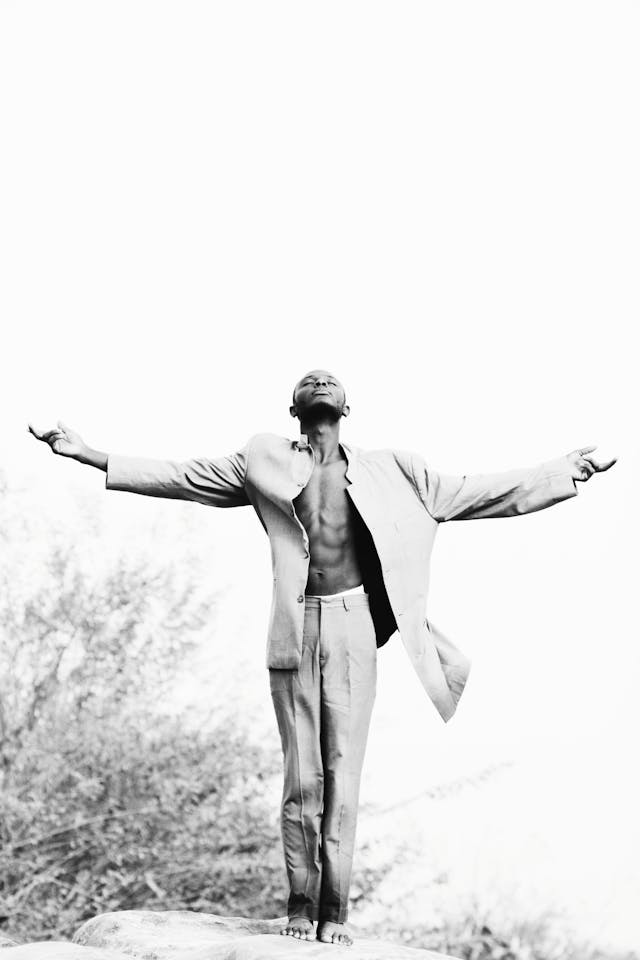
Even though much will be left unsaid, this is the final in the series. I love this picture I found for the post. I am mortal, lifting up scales to an eternal God.

An LDS friend told me her faith believes human souls are waiting in heaven for bodies. Hence, the need for large families, providing the bodies. I don’t know of Protestant faiths that believe their souls originated in heaven. Some believe it sparks to life at conception, but because God breathed life into Adam’s nostrils, I wonder if the first breath is significant. Some say our first and last intake “Yah” and exhales “Weh” makes the sound of God’s name, Yahweh.

I don’t want to focus on when the soul arrives, other than to say only God is immortal. It is arrogant thought to assume a part of us is inherently eternal. The idea of immortal souls didn’t come from Hebrew Scriptures; it came from Plato, and it’s understandable that we accept it because Greek philosophy shaped our Western thinking. The Bible Project talks about the word that is most often translated as soul here.

Return to dust, you mortals

You know the story—don’t eat from the Tree of Knowledge, or you will die. Was “die” hyperbolic? Did their soul/spirit die within their flesh at that moment? Are we assuming “you will surely die” meant God knew he would kick them out of the garden so they couldn’t eat the Tree of Life anymore, and then they would eventually die?

Job said his life came from the breath of the Almighty. After Jesus rose from the dead, he breathed on them and said, receive the Holy Spirit. So, I have wondered if this born-again breath is not connected to what perished in the garden.

All I understand is that, figurative or literal, access to the Tree of Life was granted and revoked in the garden of Eden, death entered, God desires none should perish (or die), but all would have eternal life instead—and the end of the book, Revelation 22 describes access granted to the Tree of Life again in our future so we will live forever.

It’s probably too ingrained in you, from the foundational philosophers of Western civilization, to let go of the idea that some part of you will live forever, naturally, in your own power, even in rebellion to God.

This is the context I am coming from. I do not believe any part of us is inherently eternal—and I’ve highlighted this to show my fearsome reverence for God, before I share my boldness on judging him.

“I said, ‘You are “gods”; you are all sons of the Most High.’ But you will die like mere mortals; you will fall like every other ruler.” Psalms‬ ‭82‬:‭6‬-‭7‬

Taste, and see

  • When you first turn to God, you have judged him worthy.
  • Every time you submit, and believe his definition of sin, yielding a bit more of yourself to him, you are making a judgment that you can trust him.
  • When you do not do what he commands, you are judging him untrustworthy.

We’re invited to taste and see that the Lord is good. An action that results in consideration, opinion, and finally declaring a verdict on God.

In my last post, I wrote about our divine desire for justice because we’re made in the image of the righteous judge. Do you think God would give us the desire for justice and the ability to judge, but then tell us not to use it on Him—as though the giver of that justice might not stand up to it?

This concept of measuring God is unfamiliar to me. And these are probably new thoughts for you if you were raised to fear God, hell, Satan, sinners, your parents, an unchecked government, the world, hip-hop, and yourself. But taste and see—how could you walk boldly into the throne of grace if you’ve always believed he is arbitrary, punitive, and unjust?

Look at the language God uses in Isaiah, “Come now, let’s us reason together.” This is a God who wrestles with humans. Moses and Abraham both verbally sparred with God to intercede for the ones they loved. Although love might be a strong word for what Moses felt for the Israelites…

Jeremiah has a humble posture when he comes to God and says he’d like to have a word with him, but look also at his boldness.

“Yet I would speak with you about your justice…
You will be in the right, O LORD, when I lay charges against you,
but let me put my case to you.
Why does the way of the guilty prosper?
Why do all who are treacherous thrive?”
Jeremiah 12:1

Is this not the cry of your heart right now? How much healthier to lay it out on the table than to pretend like you aren’t lifting scales and inspecting the balance, waiting to see what the Lord will do. Stand on the edge of the cliff with Abraham and the Lord and echo, “Will not the judge of the earth do right?”

Come now, first let us reason together ways not to judge God

Do not judge God by

  1. his leaders
  2. an (English) translation
  3. your limited knowledge
  4. how you think this story should end
  5. the people who smear his name
1. Do not judge God by his leaders, even the chosen ones like Saul

I mentioned last week that Eli had two sons who used their religious power in the temple to oppress financially and sexually. Eli knew about it and confronted them, but just as we saw in the recent SBC scandals (and have seen in many others) no one was punished and often not even restrained. Eli’s bloodline was supposed to be priests forever. God’s answer is that he will still honor his promise to the lineage, but the two guilty sons will die on the same day. Additionally, every descendant of theirs will die in the prime of life.

Eli still doesn’t punish them.

Samuel comes on the scene as a weaned child and in a sweet story hears God’s voice in the night. In the morning Eli wants to know what God said, but young Samuel doesn’t really want to tell him, “Uh, sir, God said your sins cannot be atoned…” Verse 14. They could not be atoned by anything Eli currently did in the temple. There was nothing set up under that priesthood that could atone for it.

But Eli convinces Samuel to be scary-honest. Verse 18, “So Samuel told him everything, hiding nothing from him. Eli replies, “He is the Lord; let him do what is good in his eyes.””

So great is the irreverence of Eli’s two sons, who have wielded religious power their whole lives, that they take the Ark of the Covenant out to the battlefield like God is also theirs to wield. 1 Sam 4 says the slaughter was great; Israel lost thirty thousand foot soldiers. The Ark of the Covenant was captured, and Eli’s two sons, Hophni and Phinehas, died (just as promised on the same day.)

When Eli hears his sons are dead and the Ark is captured—it is news of the Ark that devastates him. He was quite heavy. (Maybe he also benefited from those first-choice cuts of meat that his boys were stealing.) Eli falls back from his chair, breaks his neck, and dies. Then his daughter-in-law hears and dies giving birth. Already the family line is perishing in the prime of life. Eli had led Israel for 40 years.

God will deal with corrupt leaders—and keep his promises at the same time. That we want and need him to, illustrates how everything inside us cries out against the problem of sin and iniquity.

Rethinking Hell is a heady collection of essays from multiple scholars about conditional immortality. On page 216 note 35, one argues, “However, if God is the author of morality, God‘s own actions must ultimately be shown to conform to the moral principles God imposes on humanity…”

God presented Christ as a sacrifice of atonement…to demonstrate his righteousness. Romans 3:25–26. The fact that it’s a demonstration means it’s an invitation to observe and judge. God has come to an unbelieving world and put his character before us to win our fear, repentance, and love.

2. Do not judge God by translation philosophies

The Bible only says that it is useful for training, and not one jot of the law will pass away until everything is finished. The Bible does not say your understanding of the translation in your hand in inerrant.

I’ve talked before about spiritual bypassing and cognitive dissonance by shrugging our shoulders and saying, “The Lord is mysterious, and I can’t trust me.” Growing up in church can be a little like the story of the Emperor’s New Clothes. This is how it seemed to me when my kids started talking. They pointed out things that I had practiced ignoring. I was in the habit of believing, “I can’t understand that. I’m sinful. I’m uneducated. God is sovereign.”

Christians are sometimes the crowd around the emperor, assuring the world they see elegant clothes with cheap phrases and pat answers. That hasn’t worked for the generations who’ve had access to a wider community and can ask the internet if they don’t buy the platitudes.

Sometimes the problem is in the translation itself or the translation philosophy. Like an idiom lost to time, some words would have made sense to the reader but don’t show up anywhere else in the Bible, so the nuance has to be assumed. Sometimes it’s taking the Bible too literally, when it so often uses hyperbole. Sometimes it’s not having a comparable word in the target translation. But people dedicate their lives to digging into those things, and we also have access to those scholars, books, podcasts through the internet.

This actually happened to me this week when I read David appointed his sons as priests. I was like, “Hold the phone, they aren’t Levites!” I already suspect some of David’s motivation and political maneuvering so I needed to know what was going on.
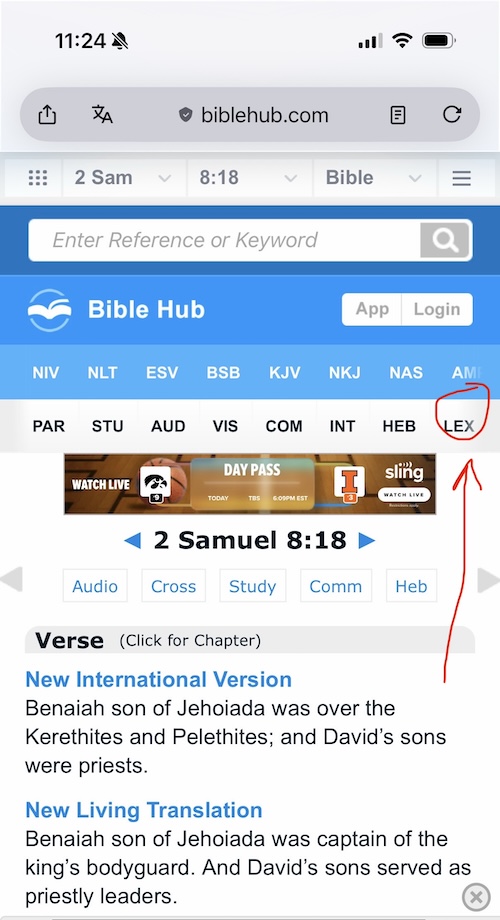
Apparently, this is a known discrepancy. Bible Hub is my favorite free resource for viewing multiple translations side by side. And the Lexicon button shows the Greek or Hebrew of the verse. If you click on a word, you can see where else it shows up in the Bible. The word used for priest regarding David’s sons does not refer to the official Aaronic Priesthood.

It’s more likely that they were officials put in charge of ministering. Neither is it the same word that we use for a kingdom of priests according to the order of Melchizedek.

Appreciate the Internet with me for a minute. Previously, it would have taken a very special complementarian pastor to answer all of a girl’s questions without assuming she wanted to usurp his authority and/or sleep with him.

I know it’s not always that simple. Some things in the Bible have no clean answer yet. If you only have a few minutes to spend in a devotional each morning, the writer probably isn’t going to highlight the Psalm, “May his children be wandering beggars; may they be driven from their ruined homes,” with a touching personal story.

That’s because, translations aside, there is tension in the Bible. It is a place where often two things are true. Consider when Jesus broke the law, broke the written law and healed a man on the Sabbath. He said in John 7:24, “Do not judge by appearances, but judge with right judgment.” He’s telling the Pharisees here that there’s something else besides the literal interpretation of what they have written down in front of them.

3. Do not judge God by what you know that you know

Because we only know a part, we have to make tea and settle into the mystery.

Consider that scholars were cranky because John the Baptist didn’t eat and drink, and equally cranky because Jesus did eat and drink.

Peter knew Christ was the Son of the living God. You can see how this plays out ten verses after he declares that truth. Peter knows what he knows and therefore contradicts when Christ tells them is going to die. Don’t judge God by the pain and death that we know doesn’t need to be happening right now. Like Peter, we don’t understand everything going on, and all the powers at play.

I believe it was the human weakness in Christ that needed to rebuke Peter’s temptation to not go to the cross. There wasn’t a problem with Peter being his normal inquisitive, impetuous self. With careful words we still call out that we don’t see any clothes on the emperor. Suppressing the thought gets you sideswiped by the enemy’s philosophies. When you tell yourself, “God is God—shut up and take the free ticket out of hell!”

The spiritual person judges all things, but is himself to be judged by no one. 1 Corinthians 2:15

4. Do not judge him on how you think something should play out

I have an annual Hallmark Christmas movie night with a writer’s group. We call out story elements, write, and rewrite the story as we’re watching. Some of the gals are shockingly spot-on, as though they wrote the screenplay. I like to try guessing cheesy lines and say them just before the character does. But genre fiction follows a predictable story arc with mandatory components. There is a reason people love it. No surprises equals “emotionally safe.”

My dad asked me when I released Stone of Asylum, “If I read this story—is it going to be worth it?” Not counting the cost for some people to suffer through a book at all—this is a question of whether he can trust me, the author, with his time and the ending. I told him, “Probably not.” My martial arts trilogy is a dark retelling of the Count of Monte Cristo. I explore the theme of revenge and how a story might unfold if a human had the power to exact it. I had fun—but my writing contains no gifts of comfort or reassurance for the reader. It takes trust to follow a writer to the end of their novel, whether or not you first check the last page to see who lives.

But even if we know “God wins,” it doesn’t mean every chapter is going to make sense. Acts 21 is interesting to me because the local church urges Paul “through the spirit” not to go to Rome. See, the Spirit revealed to them that Paul would die in Rome. One man prophesied that the owner of this belt will be bound “like this.” And Paul asked them, “Why are you weeping and breaking my heart?”

Paul knew what he was called to do. He had been told that he would stand before Caesar. The same Spirit showed both Paul and the believers the same thing, but because humans have autonomy, they had different reactions to what should be done with that information. This dethrones the idea that “I have word from the Lord for you” also means “I understand all the details and here’s what you should do with your life.”

It also reveals that even if we have a promise, the path to get there isn’t predictable like genre fiction. Abram experienced famine, war, kidnapping, and years of barrenness before his promise came. David was anointed king, but the path involved running for his life, losing his best friend (who had sworn to be his second) as well as a lot of crafty political maneuvering and marriages before he established Jerusalem as the political and religious center.

As we wait for our promises with the assurance that God will wipe every tear—understand this reality: it just means there will be tears.

He knows we will judge his trustworthiness based on his fulfillment of promises.
Fulfill your promise to your servant, so that you may be feared. Psalm 119:38.

5. Do not judge him by how others use his name

This is the one that I continually struggle with. I cannot for the life of me understand why God lets people do evil in his name. And I will leave it at that because I have no answer.

Won’t Ihen you see the phrase in the Bible, “For my name’s sake,” pay attention. Hebrews 6:13 says God swore by his own name because there was none greater. Blasphemy of the Holy Spirit is unforgivable, and most people try to reconcile “unforgivable” by saying it means rejecting the call of God even to the point of death, so you’re dead and your chance is over. But I wonder… is it not more serious than we realize when people blaspheme God’s name by falsely attributing good and evil to the point of drawing others away from him?

If people profane his name by committing atrocities and justifying it because they are “chosen,” the answer is not to cover it or look away. And it isn’t to decorate God’s actions with half-truth rationalizations. Elizabeth Eliot had a problem with the way Christians try to make God look good to defend him and said the way they fluff him is specifically a problem with Christian fiction. P. 126 & 129 Being Elizabeth by Ellen Vaughn.

It seems like many would rather protect the image of God than bear the image of God, especially when it is maligned. And protection is only needed if you do not believe he can protect his own name.

The problem of sin

The problem of sin/pain is a problem of free will and how we think God should deal with both.

Hold the tension of when Peter was indignant/ashamed/confused that Christ had de-robed and kneeled down to wash Peter’s feet. Like in so many other places, I’m glad here, Peter didn’t throw away his challenge, pretending he could see clothes.

I’m finishing a Lenten devotional this week called 40 Days of Decrease by Alicia Britt Chole. She highlights that at the Last Supper Jesus washed the feet of a betrayer, a denier, and ten deserters. He held the bread and wine out to each one, anyway.

Whether you are one of the ones who anointed him for burial weeks before, or you sit at this feast with questions and decisions—everything hangs on how you judge God.

And this is the point where we cannot cling without the grip of faith for parts yet unfulfilled or misunderstood. You can read the Bible prepared to be cranky when God eats and when he fasts—or you can look searching his loyal love. But we don’t need to pretend we see the emperor’s new clothes. Our naked king removed his own clothing and invites you to look upon him.

“God‘s character and conduct aught to win faith, not to be sustained by faith against appearances.” One of the essays in Rethinking Hell reiterates the invitation to a fallen world to judge who he is. “…we may be sure that the judge of the earth will do right, not merely in his own eyes, but in those of all his intelligent creation.” P. 199-201.

Chole also wrote in 40 Days of Decrease that the last time Judas spoke to Jesus he called him “Rabbi.” And the last time Jesus spoke to Judas, he called him “Friend.” The author explains, she remains “in that messy place theologically where God’s Sovereignty and human freewill co-exist.” P. 137.

I’m sorry that you came all this way and will not leave you with a tidy conclusion—save, trust the author to the end of the story. Confounding chapters of his grace play out everywhere you look—when you aren’t trying to write them.


Your Own Hands

Posted on January 3, 2025January 4, 2025 by Hilarey

I love the hopeful newness of January. I like resolutions. Although, if you were raised to believe you had to honor your word, it is a little painful to promise yourself something and not follow through. So, I understand those who are dead-set against resolutions. Usually, though, resolutions are all the same things that you want to do all year long. So if you haven’t trained for that marathon, lost that weight, learned a new language, gotten sober, or written your memoir yet—you break those promises to yourself every month. 

It just feels like a clean slate at the new year, and there’s something invigorating about the old-self applying to a different year in the past. Not a few days ago. It’s why I love to use this time of the year to throw away everything expired in my cupboards, fridge and cabinets. Let the bad fall away behind you and keep walking. Try again. Start over.

A marathon is not on my list this year. I never want to run one. But, a few years ago I was training to walk/run half-marathons. We were helping to raise money for AIDS orphanages in India through the ministry fiftytwo.4. If you haven’t trained six-months to run thirteen miles every Saturday in October, you may not know that the mental battle is more than half of the challenge. Sure, you train your body for endurance if you want to be able to move after each run. But you have no idea how many excuses a human can come up with until you’ve tried something uncomfortable that lasts more than one season. Though it got easier, I never did get a runner’s high, or enjoy running. I had to battle my mind at every practice run.

One time, a woman shared at our group training that God had spoken to her during her runs. He showed her she was clenching her hands too tightly. Not just literally—during the physical activity of running—but when she prayed to him while running. She was clinging to the things she loved. And it represented her fear that God would take them away from her. So, she was learning to run with her palms open and lifted to display her submission to God. So lovely! 

As a side note: it’s recently become really impactful to me to understand that God gives us agency. He allows us to open or close to him. People like to joke about how God got their attention and made them do something. Feeling compelled to act for the pleasure that is peace with God is not the same as him making you do something. If you were raised in a religious home you might have been taught obedience more than the concept of daily choice: following God because you love him. Don’t confuse the control of manwith the draw of God. You can keep your life in your own hands. 

Back to the runner’s hands: I’ve learned that when people say they’ve heard from God, I don’t need to let jealousy make me a skeptic. I just whine, “What about me, God? Do you have something for me?” That day on my run, I asked him if there was a message for me in her words. “Do I cling too tightly to the things and people I am afraid you will take away from me?”

The quick answer was no. But then I clearly heard, “But they are still clenched. You are afraid to let me give you good things.”

I looked down at my hands and tried to summon the courage to open to him. To allow God to give me good things that I might later be afraid of losing. 

I’ve written about using hands in prayer before in These Ten Things. And I read a book last year, Celebration of Discipline by Richard Foster, that suggested an exercise during prayer to lay your palms flat on your legs until you come to something that you need to give to the Lord. Then, you turn your hands over and visualize offering it up to him. It was really moving for one of my prayer partners. 

I think the physical movement keeps you present. So instead of spinning in the fear and what if, your prayer a chant of “please, please God.” You acknowledge and name a thing you cannot control, and the mindful action pulls giving that thing to the Limitless God out of the symbolic, and into something more tangible.

There is a verse about hands in Proverbs which I used to see as a warning. It says a foolish woman tears down her house down with her own hands. It isn’t at all noble if a man destroys his sanctuary—he’s still a fool—so I do wonder why it says a woman. But Solomon had a lot wives, and polygamy benefits no one, so he’d probably seen it done a few times. Maybe it has something to do with the way a physical space reflects the spirit of the one who manages it, frequently a woman. I’m not talking about clutter, but if you are in pain and chaos in your brain—there will be tension in the home. Even if it isn’t your doing, or you aren’t allowed to be in control of your house, something ethereal about the room displays the space in your head.

However, even people who can’t sit still unless there’s chaos probably don’t want to tear their home down with their own hands. I think that’s the heart behind the statement in Proverbs. 

But sometimes renovation is in order. Even with the structure that you think provides all your shelter—there is a time to build and a time to tear down.

Most of the lines in the song Poison and Wine by the Civil Wars feel like the barb twisting inside human love, but there is one line that especially applies here. “Your hands can heal. Your hands can bruise.” 

Your hands can be used for good. Your hands can be used for bad. So, in addition to scrambling after new achievements this year, I think it’s worth contemplating your own hands.

Consider if your fingers are clenched too tight to receive from God. Are they squeezing the life out of the thing you want to control, but is not yours to manage? Are they mindfully holding on to what is important and you need to cling to… but loose enough to let something go, even though you love it?

Take Luck

Posted on November 1, 2024April 18, 2025 by Hilarey

“Take Luck” was from a skit by stand-up comedian Brian Regan, where he talked about intending to say, “Take Care,” and then switching to “Good Luck,” halfway through. It’s a funny one.

I think of it when sending a meaningless salutation. To offer without really offering. Take some luck from somewhere, and have it. Keep it with you. I also think of his skit when I see generic signs that say something like, “have faith” or “be blessed!”

Have faith in what? Be blessed how? Take some luck with you—I think there’s a bowl on the counter.

James 2:16 says, “and you say, “Good-bye and have a good day; stay warm and eat well”—but then you don’t give that person any food or clothing. What good does that do?” It’s like when you pass a homeless person on a frigid night, on your way back to your car, and you call out, “Stay warm!”

There is power in words and power in prayer, and it is significant when you speak a blessing over someone’s life. That’s different from when someone has a need, you see it, and you have a tangible item like a spare coat. Something to hold on to.

Substance

Have you ever experienced making up a story about someone in your head? You go into the creepy part of Wonderland (down a dark rabbit trail.) And then when you see the person, or talk to them, you know right away that none of it is true. Your theory had no substance. Nothing to hold on to.

All it took was a conversation to find out the truth.

This used to be the annoying thing about simple romances to me when I was a young girl… especially because I value (kind) directness. I could never get behind a heroine whose entire conflict was a misunderstanding or an unspoken clarification. If they would just have that conversation already, there would be no book.

I have another quote from Good Boundaries and Goodbyes by Lisa Terkeurst, since it’s what I’m reading right now, “Relationships often die not because of conversations that were had but rather conversations that were needed, but never had.”

It’s true, we can write out scenarios that seem like reality. And then a bit of truth, not even a deep dive, and we find out differently.

Making it up

We watched a few episodes of the Good Place and their funny world-building includes a heaven that “no one could imagine.” They have a picture in heaven’s office of a guy who got really stoned and said, “This is what I think heaven will totally be like.” He’s heralded as the guru who got the closest.

It’s meant to be hilarious, but many people treat things of God, and eternity this way.

Most people believe they are critical thinkers, not emotional. But faith without substance is stoned-luck. No matter how critically you look at the void, it’s still empty.

Scales and measuring cups

My friend mentioned something to me that has proved itself true again and again. She said she thought she was eating in her caloric budget until she started writing things down. I’ve seen it myself. Recently, I saw somebody order something in a restaurant that looked delicious. So I tried to copy it at home. I made a light shrimp and fettuccine salad. But when I added it to MyFitnessPal, it was 800 calories. The restaurant had served double. Not exactly a light lunch.

And even more than just logging what you’re eating, you can think that something looks like an appropriate portion—until you weigh it. It’s doubtful that the average eater actually knows what 25 grams of fiber looks like over the course of a day. Due to years of cooking, I can judge weight and volume close to accurate and often cook without measuring. But when it really matters, I still get out the scale.

So, upon closer inspection, you see details more accurately when you actually weigh yourself against the Bible.

And let’s be honest, another interesting correlation is that the days I don’t want to obey or know the scale… those are the days I don’t measure food. So there’s a submission/discipline factor of not wanting to know if I measure up. Sometimes I just want to eat like an asshole. This is likely a larger contributing factor (besides laziness or time management) for not looking in the Bible. We don’t want to see if we measure up.

But here’s the problem, someone who is a Christian, but doesn’t read the Bible, is really susceptible to the weird tangents of Christian religion. Taking someone else’s word for what the scriptures say inevitably lays the groundwork for future deconstruction. This is what children do: accept the world through the lens and experience of those over them. This is not what a maturing Christian does.

You don’t want to have a void or ungrounded faith that can’t weather storms. Take some luck, and keep it with you. Care for it.

So, you can be frustrated with what you think about God. You can be frustrated with what you think about the church. But if you’re not holding it up to a depth of study in the word, you are not frustrated with substance. You’re following a rabbit down a hole. If you look at the way the letters to the church explained the right way to live—and then you see how Christians are disobeying—that’s something to hold on to.

I used to get annoyed when I saw a verse partially quoted. (Romans 8:1a) But then I realized that the chapters and verses were added. So even memorizing a whole verse can miss the larger context. That isn’t even to mention re-wording and misquoting. I’ve seen people defend mis-worded scripture with tears. This happens when you “already know what it says” before you read it. But that’s another topic.

I love a quote I heard from Theologian Preston Sprinkle. He says, “Let the strength of your conviction reflect the depth of your study.” Pick the mountain you’ll die on.

You are doing yourself an extreme disservice if you hold your convictions tight in your head and heart, without opening the Bible to check their weight.

So the point is, get out the scales. Grab on to something solid. Read for yourself.

The Heart, Mind and Soul of the Matter

Posted on October 25, 2024 by Hilarey

When my kids were still at home, we sometimes ate standing at the counter, buffet style, without plates. This was for charcuterie-type meals like chips, veggies, dip, cheese and crackers. It was typically a pre-holiday event so people could come and go. But sometimes, late, and after karate, it was just to get a meal started as we were still pulling food out. It could be a frenzy of laughing, talking, and reaching.

My son told me recently that even if the food itself isn’t comfort food, it is a comfort to him to have a meal this way because of the memory of it. He also said his roommate had no context for a family meal like this because his mom always plated his food.

I’ve done that, too. And I’ve known people irritated by their childhood mealtime because they had to clean their plate, but weren’t in charge of what was on it. So I’ve been thinking about the heart behind the action.

Picture a mom dishing up everyone’s plate. She chooses your portion and sets it before you. She could do it this way for more than one reason.

Maybe:
She wants to see your delight when she places the plate in front of you, and she’s simply helping you.
She is selecting the best cut of meat for you.
She is selecting the best cut of meat for herself.
She is selecting the best cut of meat for your volatile dad, so he’s appeased and everybody might get to finish dinner.
She doesn’t want to clean up after everyone else’s messy attempt to serve.
It is all about control, and she’s trying to make sure you don’t overeat because she thinks you’re fat.
It’s all about insecurity and she wants to remind you that the food comes from her, and her only personality in this season of life is feeding people.
There’s someone greedy at the table who would fish out all of the meat and leave everyone else only broth.
Someone’s hangry at the table, and it just streamlines the meal.
It’s the only thing she is in charge of.
It’s for love and worry that she wants to make sure you eat the right foods, not just white bread.
There is barely enough to go around and she is making sure that you get a fair portion.
Food is scarce, and she’s rationing to fund a second meal.
And maybe, she’s not just sure why her mom served everyone—but she feels like she can’t break tradition.

The thing is, you can only assume her motivation—and whether there is more than one motivation contributing.

This isn’t a post about forgiving moms for our eating disorders.

It’s just to describe why God is after our heart.

We are often very conscious of how our actions look or are perceived by others. But actions can be faked. They can just be a rule or a tradition. Actions don’t tell the entire story.

Just because there is a lack of a sin you can pinpoint and cry out, “There! That thing you did was wrong.” It doesn’t mean wrong wasn’t done.

Actions, Motivations and Iniquity

I’m reading Good Boundaries and Good Byes by Lisa Terkurst, and she writes, “I discovered iniquity points to the character or motivation of the action more than the action itself. So it’s not just what someone does or doesn’t do; it’s what her actions represent.” The author uses this to describe when we cannot really pinpoint something as a sin. More the “nuances of hurtful issues within human relationships that don’t clearly point to sin.”

The same tradition can bring life to one household and oppression to another. Even in the same house, a rule can be life-giving or demeaning. Not every one of my family members had pleasant emotions about those meals at the counter.

What’s the difference? Sometimes the situation or personality of the one who receives, affects it. The person who gets the food put on their plate. But mostly—the difference in how actions affect you is the heart behind it (or the rule and how it’s enforced.)

Anything can be twisted by motivation.

So be careful when giving or receiving advice, or following new parenting trends.

And damage isn’t only a result of a malicious motivation. So many things I did incorrectly as a parent were motivated by fear. Which seemed like it came from love, but it was still tainted because fear isn’t from God. I always want to be cognizant when fear motivates my actions.

And to try to turn over my heart. It isn’t just the sin of murder— it’s also the justification of anger. It isn’t just adultery—it’s the lingering.

Don’t Give Up

In those situations where the heart was sincere but the action still created pain and discord—I think the motivation of the heart is redeeming. I know a mom who asked her kids, “Yes, but… when you look back, can you ever say that I did not love you?”

And even if that question is not given a thoughtful answer, our God cares about our why. That’s not to say obedience isn’t required to follow him. But loving God with your heart, mind and soul comes first. Then, loving your neighbor as yourself follows. And that neighbor interaction has to overflow with sincerity of heart, or it gets weird.

“The LORD does not look at the things people look at. People look at the outward appearance, but the LORD looks at the heart.” 1 Samuel 16:7.

I think there can be dread to give God your heart because you think he‘ll make you change your actions. Our purpose isn’t so much to focus on whether or not mom should plate the food or what does God want me to do? But to let him in. To love him. To be loved by him.

God’s kingdom will not be brought by changing certain actions, voting, laws, force, hostile takeovers or outlawing sin. It is what the Jews wanted when Rome was oppressing them. It’s what many people want now, one world system to throw off the oppression of a different world system.

Neither will God’s name be glorified by a segregated utopia—yes, a holy people, sanctified and set apart—but not living behind a gate hoarding and protecting their resources of joy, love, and prosperity. When I was a child, I used to think Christians should be immediately raptured. I didn’t know why we had to live here. I thought God should just talk to individual hearts and then we should disappear.

God’s kingdom arrives through our internal renewal while we are still mucking around here in the mess. Sanctification comes from turning over our hearts.

God’s motivation

Some see God as punitive: he sent his son as punishment for our sins.

Some view our God as a reconciler: he created a path for us to be reunited to him.

(Actually, I think the difference might originate in Eastern Orthodoxy and western traditions.)

Does it matter though—if one of those statements is more true than the other… so long as you turn from sin and walk the straight and narrow? So long as the actions are “right,” and the food is served correctly?

Well, yes, it might a little, when it comes to trusting him with your heart.

Praying Naked

Posted on October 4, 2024October 3, 2024 by Hilarey

Even though I only wanted to escape eternal burning and torture, I know my 11 year old conversion was real, because after, I felt compelled to promise to God that I wouldn’t lie anymore. A handful of years later, when I tried to walk away from my faith, I’d actually become so bad at lying that I had to intentionally practice.

I always believed honesty was the best policy: withhold nothing. But truths can lose their significance and feelings change, so it isn’t always wise to unwrap everything. We can give “honesty” just as a way to cut people, with no desire for reconciliation. Because of this, I’ve been thinking of the proverb that calls it wisdom to conceal something, rather than separating close friends.

I know it is partly due to my Enneagram 4 personality to intensely crave authenticity. Sometimes I need to let that go, and grow in this area. Not everything needs to be out on the table all the time.

Because, it isn’t safe to be honest with all people. Sometimes your secret is dismissed as insignificant. Pearls trampled.

Sometimes it’s one-sided. People will expect your vulnerability even though they withhold.

And sometimes, it’s held against you forever. Your honesty will not be forgiven. Picture a doctor who makes a mistake, or the first person to be sorry in a fender bender.

I am as quick to apologize as I am to be honest. And I’ve been told females apologize more. And of course it’s always that question, nature or nurture? When I think about the weird passage in 1st Timothy chapter 2, how a woman should remain quiet—because Adam was formed first and Eve was deceived—I assume women have been apologizing since the fall. Even though man was not deceived (he willfully disobeyed) his first reaction was to cast blame on woman. So our go-to from childhood is, “Sorry about everything, boys. What else can I do to make it easier for you to not sin?”

Joking aside, it isn’t safe to be truthful with all people. But with a warning, admitting that you were wrong is a path to mutual healing when you have actually wronged someone. (If you’ve been wronged, you can heal without them.)

Honesty for honesty’s sake

One thing for sure, our God is not in the business concealing sin without dealing with it. So I definitely don’t mean withholding justice. But that isn’t the same as honesty for honesty’s sake. I heard author Tiffany Bluhm speak this year and she said, “Justice is what love looks like in public.”

There was a book I read a few years ago called Three Kings. It talked about the different ways of handling sin in leadership of your church. It compared Saul, David and Absalom. Basically, it said to not touch the Lord’s anointed. To be like David, and let God remove Saul.

I agree with the book because God did remove Saul. But I disagree in that God didn’t keep David silent or Saul’s sins covered while he did it. The book indicates that God should do the exposing. Too often, people have tried to protect the image of God, or the image of church, by hiding things. If you think you need to protect, falsify, or coverup sin in the body—then you’re either the petri dish or the cancer.

I am honest in my blog and fiction writing, even though it bites me sometimes, because I more frequently hear how helpful and healing it is to others. Certainly, more damage has been done in the church by hiding how we really feel and think and act. So, I press on and work through my reoccurring dream connected to writing: I’m in a crowded public place and need to relieve myself, usually, diarrhea. Typically, I’m desperately looking for a private place. Also typically, the only thing available is a widely exposed toilet where everyone can watch. I wake wondering, how much of my crap should I show?

I’m still working that out.

Laying yourself bare

Before I accidentally deleted my blog, a short post with this same name (Praying Naked) was the most popular on my site. I’ve added several thoughts as I’m now more prone to look at things from multiple angles. Ten years ago, when I first wrote it, someone had told me that I should never pray naked… he said it was especially disrespectful doing something base, such as using the toilet. I guess, because of poop.

I bristled right away. But I wasn’t sure why. Women don’t actually have as much luxury as men for privacy. Even sex is more invasive and intrusive. Pregnancy means you share everything, not just your body with another human. Because sometimes you share it with whoever wants to be part of the miracle by touching you. Doctors are always up inside your business. And then when you give birth, your body will be put on a pedestal for others to watch. You’ll be laying on your back so it’s easier for them to see. And during delivery, sometimes, you poop.

While I discussed that warning to not pray on the toilet, my son told me something he’d read. It was you stimulate a heart change if you physically humble yourself before God.

Basically, the point was to kneel when you pray so get the most out of it. As a result, my son said rarely had time to pray, correctly. I guess the infirm would be out of luck.

Here’s the danger for teachers: humans love dogma and a repeatable self-help path. There seems to be a hope in formulas that might bypass the struggle of faith, with zero sacrifice, and with results one can replicate. The person who found that heart change by kneeling might have had a sincere experience. Maybe also did the man who told me to never do something base while talking to God.

But, I’ve had Norovirus. Anyone who’s had that, dysentery or hepatitis has prayed on the toilet.

Even though mankind started off naked, the idea does come from somewhere. There were laws regarding nakedness in the Old Testament. For example, the last verse of exodus 20, warns them not to expose their privates to the temple steps while they walk up them.

I think the point of laws like that were to make us realize who we approach. God Almighty should induce a little fearful awe. Mount Sinai could not be touched without penalty. The law had to come to do that.

It shouldn’t stay there though. We now approach Mount Zion through Christ. You can call out to God, even with a gross body. You do not need to get dressed and move to your knees, be healed from infections, and then stoically place your palms together. You don’t need to get your shit together first.

The ridiculous idea of needing to cover your nakedness to be presentable to God is worse than missionaries trying to decorate their proselytes in their home fashion. Hiding your baseness from God is your own version of fig leaves, of covering up your own sin. There was a fig tree I loved to climb as a girl. But the leaves were itchy—I couldn’t stand them against my skin. There might be different varieties of fig trees, but the thought of covering my nakedness before God stays with me as a second-rate, hydrocortisone option.

Of course, if this intent is misconstrued, some might think I advocate irreverence. Or that we shouldn’t bow before him. I think if we had a clear picture about what was happening during prayer, we wouldn’t even go to our knees. We’d fall to our face.

We should have reverence. Hebrews 5:7 says Jesus’s prayers were answered because of it. But a few chapters before that Hebrews 4:13-16 says no creature is hidden from his sight. All of us are naked and exposed. Nevertheless, he is a high priest who understands our weakness and we are told to draw near with confidence to receive mercy, grace and help.

No creature is hidden from his sight, naked and exposed

It’s silly to withhold anything from him, even the unsightly functions of the human body. A young woman once shared with me that the comment about not speaking to God while you went potty felt so oppressive, it broke her heart. Because, in her busy life, the toilet was the only minute she had alone with God each day. It is interesting that the Bible mentions not even nakedness can separate us from him.

A book that ministered to me a few years ago was the Liturgy Of the Ordinary by Tish Harrison Warren. It includes a pretty visceral prayer:

“Observant Jews use a prayer called the Asher Yatzar, which they recite after using the bathroom. Blessed are You, Hashem our God, King of the universe, Who formed man with wisdom and created within him many openings and many hollows. It is obvious and known before Your Throne of Glory that if even one of them ruptures, or if even one of them becomes blocked, it would be impossible to survive and to stand before You (even for a short period). Blessed are You, Hashem, Who heals all flesh and acts wondrously.”

The most powerful prayer warriors I know don’t worry too much about how to approach the God they dearly love. My two prayer partners arrive often and entitled, knowing God will hear them, trusting their father so much that they don’t need him to do what they ask in order to continue in faith. Often because they were told to pray without ceasing and entitled because they believe that they can boldly approach the throne of grace.


Tradition teaches us to bow our heads and get on our knees. Jesus lifted his eyes. Keep in mind it is the condition of your heart which is important—not yoga poses or deciduous matter on your privates.

Remember who you approach: God Most High. Remember why you approach him: Christ made it possible.

Beyond that, I doubt God is any more fazed by your baseness than impressed with your lovely new outfit.

Just as I am

There is a deep need to be known fully and accepted fully. The possibility of the first and not the second, motivates both unneeded honesty and shame. What we are ultimately searching for though, is to have complete naked vulnerability before God. To pray without any shame or anything covered between you and him.

Sometimes it just seems more real when the exposure and acceptance comes from others.

Just make sure it is the right amount of exposure to the right person. Because, I don’t see God’s solution to our sin as returning to the garden nakedness when we go to heaven. Not everything needs to be laid bare to everyone.

Even though nakedness and the tree of life started off our story—the next time we eat of the tree we will be covered in white robes. Figurative or literal? I don’t know, but lift up your eyes and do not be ashamed. Your nakedness is fully seen, known and accepted. He’s got you covered.

  • 1
  • 2
  • 3
  • 4
  • Next
Judge Yourself & Let No One Judge You

Judge Yourself & Let No One Judge You

Just as you have to make self-examination/judgment a discipline, make accepting forgiveness and walking in light a similar “conscious discipline.” You look at your sin. You accept that you are...

Read More
Judge No One & Judge Others

Judge No One & Judge Others

2 of 3 | Part 1 Judge Yourself & Let No One Judge You | Part 2 Judge No One & Judge Others | Part 3 Judge God “So don’t judge...

Read More
Judge God

Judge God

Whether you are one who anointed him for burial weeks before, or you sit at this feast with questions and decisions—everything hangs on how you judge God....

Read More
In All Your Right-Rightness

In All Your Right-Rightness

They will know we are Christians by our doctrinal precision....

Read More
Of Mystics and Medicine

Of Mystics and Medicine

If it benefits humanity outside of a religious context, can the church still touch it? ...

Read More
Kicking Bricks & Flipping Tables prayers in cracks of the wailing wall, 2018

Kicking Bricks & Flipping Tables

I’ve heard foundations cannot be changed. (I feel like this is said when people describe how America was started as a Christian nation and therefore it could never not be...

Read More
The Wife Follower

The Wife Follower

the husband leader | the wife follower I’m realizing that questioning the husband-leader-dynamic is part of the larger debate about women in the church. (I’m usually late to the circus.) And...

Read More
The Husband Leader

The Husband Leader

the husband leader | the wife follower There was a time early in my marriage when my husband wanted to go into partnership with someone to buy a karate school. We’d...

Read More
Uncovering Paul

Uncovering Paul

Paul’s command in 1 Corinthians 11 to keep a woman’s head covered was more about protection and equality for the first century church than keeping a modern woman subservient in...

Read More
It’s Probably Her Fault

It’s Probably Her Fault

I loved the first cover of my first novel. Partly because, 11 years ago, it communicated to the reader: this isn’t going to be your typical Christian fiction. I didn’t...

Read More
A Ceremony of Grief

A Ceremony of Grief

Some kinds of deaths don’t have a memorial or funeral. It helps to have a ritual to mark the end of broken dreams so you can move on....

Read More
Dismantling Human Tradition

Dismantling Human Tradition

When I was young, I told my mom a name I wanted to give to a future child. Her quick response was that if my future husband had ever known...

Read More
Take Luck

Take Luck

Someone who is a Christian, but doesn’t read the Bible, is really susceptible to the weird tangents of Christian religion. Taking someone else’s word for what the scriptures say inevitably...

Read More
One Body, One Hope—But it Looks Different

One Body, One Hope—But it Looks Different

Jesus Christ introduces and represents himself differently to the seven churches. Superficially we can look at this is and realize, he’s different to different people. It’s true, you can find...

Read More
Abide in me

Abide in me

A few years ago, one of my prayer partners received the word "abide" from God, and so we spent a fair amount of time talking about it. But first, we had...

Read More
Giving, Accepting and Celebrating Love

Giving, Accepting and Celebrating Love

I received some council this week, which I desperately needed. And I will share some of my thoughts processing it in honor of today. If you swing from opposite ends between...

Read More
Your Own Hands

Your Own Hands

I love the hopeful newness of January. I like resolutions. Although, if you were raised to believe you had to honor your word, it is a little painful to promise...

Read More
Violence on a Soul

Violence on a Soul

My husband and I are reading “The Ruthless Elimination of Hurry.” One night, we came across a phrase that made both of us pause—but we’d had very different reactions. The phrase...

Read More
So Many Voices

So Many Voices

What do you do when lies are shared from the pulpit? Do you get up and quietly leave? Do you create dissension with your whispering and try to stage a...

Read More
The Heart, Mind and Soul of the Matter

The Heart, Mind and Soul of the Matter

The same tradition can bring life to one household and oppression to another. Even in the same house, a rule can be life giving or demeaning....

Read More
Sonship and Citizenship

Sonship and Citizenship

I remember standing on the deck of a beautiful home in Tahoe for a home group gathering. The leader responded to my compliment about the view, his home, and yard...

Read More
Praying Naked

Praying Naked

Even though I only wanted to escape eternal burning and torture, I know my 11 year old conversion was real, because after, I felt compelled to promise to God that...

Read More
My Elevator Pitch

My Elevator Pitch

I remember when I first moved to the Boise area. I didn’t work outside the home, or know anyone, so at church I tried to introduce myself. Every week. In the...

Read More
Please Wait, Still (Verbal) Processing…

Please Wait, Still (Verbal) Processing…

Originally Posted on June 27, 2022 The day my daughter turned 18, she sought me out and asked breathlessly, “So, when does it happen?” I looked at her earnest face and...

Read More
These Ten Things

These Ten Things

There was once a woman who perfectly copied her mother's treasured pot roast recipe. First, she took the roast and cut off both ends. Then she put it in the...

Read More
You Missed the Boat

You Missed the Boat

A re-post since I'm cranky that I have covid again. Also, we lost the little guy in this video about a month ago. If sarcasm (the lowest form of wit)...

Read More
Your Villain… a Caricature

Your Villain… a Caricature

Is the enemy chaotic-evil and unredeemable? I learned in a writing class that no one is a hundred percent evil, so, writing your novel’s villain that way will actually make him...

Read More
I Am the Church

I Am the Church

I thought I'd get this blog going again sooner, but I spent the last several months creating a website for our writer's group and a narrating a...

Read More
Blessed is Everyone Who Eats Bread in the Kingdom of God

Blessed is Everyone Who Eats Bread in the Kingdom of

The first time I heard the scripture in Matthew 7:21-23, I quickly applied it to others. In subsequent readings, it unsettled me. I've come to a place where it keeps...

Read More
Your Redemption Draws Near

Your Redemption Draws Near

I once said to my grandma, "I wish Jesus would come back." It wasn’t during a trial. I think I was just feeling the irritation of living. I had a...

Read More
Children of the Wilderness

Children of the Wilderness

The Israelite children who grew up in the desert saw nothing but provision and miracles. They didn’t know that normal shoes wear down each year. They took for granted food...

Read More
Who, what, where, when, why the hell?

Who, what, where, when, why the hell?

Questioning hell When I first heard the gospel, it was good news. Everybody was going to hell where there would be eternal, unbearable punishment…wait, here’s the good part: I didn’t have...

Read More
Making Time for Intimacy

Making Time for Intimacy

Repost: Originally posted October 3, 2022 I’m trying to practice the rhythm of consistency, but sometimes it’s not possible. Last week’s blog was quarantined as non-essential and stayed inside. Rhythm There are people...

Read More
The Ordination of Humankind

The Ordination of Humankind

Twelve is a significant number in the Bible. There were 12 tribes of Israel, and Jesus chose 12 disciples. He even chose 12 knowing there would be one who was...

Read More
Just before you came in...

Just before you came in...

Years ago, I was at a home group where everyone discussed works versus faith. We're saved by grace through faith, but the idea of this necessary component of works comes from...

Read More
Here's What You Need to Do

Here's What You Need to Do

Recently, we watched a television series called Ted Lasso. It's about an American football coach who goes to England to coach a British football team (soccer). There are three guys...

Read More
Uncovered

Uncovered

I once asked my pastor why a woman had to have her hair covered in church. He gave me so many words that it was clear he didn’t know. During...

Read More
What No Eye Has Seen

What No Eye Has Seen

I’ve been contemplating hell for the last year and a half, and I’ll post about that soon. But first, I wanted to share some thoughts about Heaven. Just musings. I...

Read More
My Immortality

My Immortality

In literature, you often see a closing image that highlights or completes the opening image. It can be for good or for bad. It brings the theme full-circle. Sometimes it’s...

Read More
Unquestioning Obedience

Unquestioning Obedience

I think I always trusted that you could wrestle with God, but felt there was a warning, or at least a caveat. If you wrestle with him, you’ll come away...

Read More
The Things That Are God's

The Things That Are God's

I'm not thinking of taxes, yet. I will be in a few weeks when I sit down to organize everything. I'm just thinking about how much I love the interaction...

Read More
Tramplin' all the way. Ha Ha. Ha.

Tramplin' all the way. Ha Ha. Ha.

Are your nativities put away and your Christmas cleaned up? If you were a Christian in the 90s, you may remember a saying, “If it became illegal to be a Christian,...

Read More
Oh the Molehills I've Died Upon

Oh the Molehills I've Died Upon

I believe there are mutually exclusive truths about God. I just don’t accept that humans have all the details—or that we will have them this side of eternity....

Read More
Before You Receive

Before You Receive

It's hard to be vulnerable enough to receive with thankfulness. Don't make these assumptions when you receive gifts....

Read More
Before You Give

Before You Give

Things to think about before you give and receive gifts in our privileged society....

Read More
On the Floor, Not at the Table

On the Floor, Not at the Table

It’s my understanding that sitting at a Rabbi’s feet showed a posture of learning. You were their disciple if you sat at there. This is why it was so significant...

Read More
For Your Viewing Pleasure

For Your Viewing Pleasure

You weren’t made for the sole viewing pleasure of the masses....

Read More
The Hevel that You Know

The Hevel that You Know

The point of our life is not to vote for the hevel that you know, but to bring God’s kingdom to earth as it operates in heaven....

Read More
Why You Matter

Why You Matter

Last weekend I spoke at the first Fall Gathering for IdaHope Christian Writers and I wanted to share my talk here....

Read More

Help change a life

Visit Cure.org to contribute

Subscribe

You can receive this blog always unsubscribe by email.

Writing devos by Hilarey

Hilarey is the President of IdaHope Christian Writers in Boise, Idaho.

Hilarey recently read

Yours Truly
Part of Your World
Wishing for Mistletoe
Book Lovers
Iron Flame
Tiny Beautiful Things: Advice from Dear Sugar
A Girl Called Samson
Scythe
The Unknown Beloved
Whalefall
The Honey Witch
Just for the Summer
Being Elisabeth Elliot: The Authorized Biography: Elisabeth’s Later Years
The Galveston Diet: The Doctor-Developed, Patient-Proven Plan to Burn Fat and Tame Your Hormonal Symptoms
Exiles: The Church in the Shadow of Empire
Fourth Wing
A Wrinkle in Time
One Summer in Savannah
Daisy Jones & The Six
Other Birds

Search this blog

Read more about

aging beauty Bible church-hurt churchyard community creativity deconstruction dismantling equality eternity family freedom freewill heaven hell intimacy with God intimacy with others irreverence love marriage nationalism priesthood privileges prodigals relationships remain on the vine traditions trust wisdom writing

Recent posts

  • April 3, 2026 by Hilarey Judge God
  • March 20, 2026 by Hilarey Judge No One & Judge Others
  • March 6, 2026 by Hilarey Judge Yourself & Let No One Judge You
  • October 10, 2025 by Hilarey In All Your Right-Rightness
  • September 5, 2025 by Hilarey Of Mystics and Medicine

Popular posts & pages

Unquestioning ObedienceUnquestioning Obedience
Abide in meAbide in me
Stone of AsylumStone of Asylum
©2026 Hilarey.com
 

Loading Comments...